

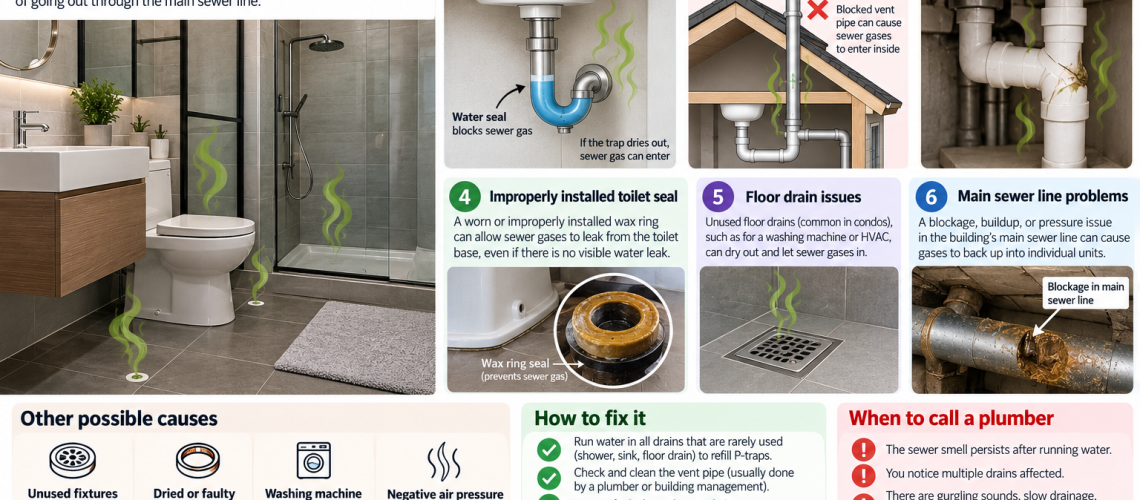

That rotten-egg odour is hard to ignore and harder to explain when the room looks spotless. In a house, the reason why your bathroom smells like sewage is usually in your own pipes. In a condo, a sewer odour in bathroom fixtures can also come from the building: the shared drain stack, the roof vents or a suite on another floor. The good news is that most cases start with something simple, and you can rule those out in an afternoon before calling anyone.
What You Are Actually Smelling?
Sewer gas is a mix of gases that forms as waste breaks down in the drain system. The rotten-egg note comes mainly from hydrogen sulfide. Every drain in your suite connects to the building’s stack, so that gas is always present a short distance below the floor.
To see what causes sewer smell in condo bathroom fixtures, start with the trap, a small pocket of water in the curved section of pipe under each fixture that keeps the gas out. When a condo bathroom smells like sewage, one of three things usually happens: a trap has lost its water, a seal has failed, or gas is escaping from a pipe before it ever reaches a trap.
Find the Source by Where the Smell Is Strongest
Walk through the room and sniff close to each fixture, the floor and the walls. A sewer gas smell in a condo bathroom is strongest right next to its source, which narrows things down fast.
| Where it is strongest | Most likely cause |
|---|---|
| One drain you rarely use | Dry trap |
| Base of the toilet | Failed wax ring or loose toilet |
| Shower or tub drain | Biofilm, hair or a dry trap |
| Sink, especially the overflow hole | Gunk in the overflow channel or trap |
| A wall or the ceiling | Cracked pipe or loose joint inside the wall |
| Several drains at once, or a neighbour has it too | Building stack or vent problem |
| Only after neighbours upstairs flush or drain a tub | Pressure swings in the building stack |
A Dry Trap in a Drain You Rarely Use
This is the most common reason a condo bathroom drain smells like sewage, and the easiest to fix. Water in a trap slowly evaporates, faster in the dry air of a heated condo in winter. A guest bathroom, a bathtub nobody uses or a floor drain can lose its seal within weeks, which is why a bathroom floor drain smells like sewage so often in condos. The dry p-trap smell usually appears from one drain only and gets stronger after you have been away. In condos it often shows up in suites that sit empty between tenants or while owners spend the winter away, and in second bathrooms that guests rarely use. Some newer buildings have trap primers, small lines that refill floor drains automatically. If one stops working, the floor drain dries out even when the rest of the bathroom is in daily use.
When the Toilet Smells Like Sewer
A toilet sits on a wax ring that seals it to the drain pipe in the floor. If the toilet rocks were reinstalled during a renovation, or the bolts have loosened, that ring can break and let gas escape around the base. You may also see a water stain on the floor or ceiling below. When the toilet bowl smells like sewer right after flushing, a partly blocked vent may be pulling water out of the bowl.
Other toilet-related causes include a crack in the bowl or tank and a hairline crack in the flange underneath. Tightening the bolts can help briefly, but a broken wax ring has to be replaced, which means lifting the toilet. In a condo, a failed wax ring often shows up first as a stain on the ceiling of the suite below, so a call from a neighbour may be the earliest sign. Many boards also require notice before a toilet is lifted or replaced, so check the building rules before booking the work.

Sewer Smell From Shower Drain or Tub
Hair, soap and skin cells build up into a slimy film on the pipe walls just below the drain cover. Bacteria feeding on that film give off a smell that is easy to mistake for sewer gas. Remove the cover and clean the first section of pipe with a brush, then flush with hot water. An enzyme drain cleaner works on biofilm without damaging older pipes, unlike harsh chemical cleaners.
In bathtubs, check the overflow plate too. The gasket behind it can fail and let odours from the overflow tube into the room.
Why Your Bathroom Sink Smells Like Sewage?
Most bathroom sinks have an overflow hole near the rim that connects to the drain through a hidden channel. Toothpaste, soap and hair collect in it and start to smell. If the sewer smell from bathroom sink drains disappears when you plug the overflow hole with your finger, the channel is the source. Clean it with a bottle brush and flush it with hot water. If the odour stays, unscrew the trap under the sink and clean it, checking the washers for cracks when you put it back.
When the Smell Comes From the Building’s Pipes
When every trap in the suite holds water and the toilet is sealed, the answer to why does my condo bathroom smell like sewer usually lies in the shared plumbing. Causes that are specific to multi-storey buildings include:
- Pressure swings in the stack. When a large volume of water falls down a tall drain stack, it can push or pull air hard enough to empty traps on lower floors. You may hear your toilet or drains gurgle when neighbours drain a tub.
- A vacant suite nearby. If a unit on another floor stands empty for months, its traps dry out and gas escapes into the shared walls and corridors.
- A blocked roof vent. Vents let gas escape above the roof and let air into the pipes. Ice, debris or a bird nest can block them, and the gas then finds its way out through the weakest trap. In a two-storey condo townhouse, a blocked vent is also a common reason an upstairs bathroom smells like sewage.
- A cracked or corroded stack. Older buildings often have cast iron stacks that corrode from the inside. A crack inside a wall lets gas out with no visible water.
- A powerful exhaust fan. In a tightly sealed suite, a strong bathroom or kitchen fan lowers the air pressure and can draw gas through a weak trap.
These problems need a plumber who works on shared stacks and vents. Building systems are usually checked with a smoke test or a camera inspection as part of condo and high-rise plumbing service, arranged through the condominium corporation.
Condo Situations That Make the Odour Worse
A sewer gas smell in bathroom fixtures that appears suddenly often follows a change somewhere else in the building. These causes only show up in multi-unit buildings:
- Water shutdowns for riser work. When the building drains its risers for repairs, traps in some suites can be pulled dry, and the odour appears once the water comes back on.
- Renovations in another suite. A drain left open or poorly capped during a neighbour’s bathroom or kitchen remodel lets gas into the shared walls.
- Empty or short-term rental units. Suites that sit unused for weeks lose their trap seals, and the gas can travel through shared pipe chases to occupied units.
- Deficiencies in a new building. Missing vent connections or unglued joints are common items on a new condo’s deficiency list, usually raised by the condominium corporation under the builder’s warranty for common elements.
If the problem started around one of these events, mention it when you contact management. It helps the plumber narrow the search to a specific stack, floor or suite.
Who Pays for the Repair in a Condo
Whether the toilet smells like sewer or the shared stack is leaking, responsibility depends on your condo’s declaration, but the split usually looks like this.
| Where the problem is | Usually responsible |
|---|---|
| Traps, toilet, sink and shower in your suite | Unit owner |
| Drain pipes inside your walls that serve only your suite | Often the owner, check the declaration |
| Shared drain stack and branch lines | Condominium corporation |
| Roof vents | Condominium corporation |
| Dry traps or a leak in another suite | That owner, through management |
If you suspect a building-level cause, report it to property management in writing and include:
- which fixtures are affected and where the odour is strongest;
- the times it appears, especially after rain or heavy water use upstairs;
- whether neighbours on your floor or the floors above and below have noticed it;
- any recent work in the building, such as a water shutdown or a renovation nearby.
A written report creates a record, which matters if the problem keeps coming back and the corporation has to bring in a plumber for the shared lines.
How to Get Rid of Sewer Smell in Bathroom?
Work from the simplest fix to the most involved one:
- Run water in every drain and flush every toilet, including ones you rarely use, to clear any dry p-trap smell.
- Clean the shower drain, the tub overflow and the sink overflow channel.
- Check whether the toilet rocks and look for stains around its base.
- Turn off the exhaust fan for a day and see whether anything changes.
- Ask management and neighbours whether anyone else has noticed it.
- If none of this helps, book a plumber to test the drains with smoke or a camera.
A cracked pipe or loose joint inside the wall can’t be fixed from the outside, and drain repair of the affected section is the only lasting solution. Air fresheners, bleach and scented drain products only mask the odour while gas keeps escaping.
FAQ
It can kill bacteria at the drain opening for a while, but it does nothing for a dry trap, a broken seal or a cracked pipe. Mixing bleach with other drain cleaners can also release toxic fumes.
Yes. Common causes in new buildings are a trap that was never connected properly, an unsealed pipe joint inside a wall or a floor drain without a priming line. Report it to the builder while the new home warranty is still in effect.
It depends on humidity and temperature. In a heated condo in winter, a drain that is never used can lose its seal within a few weeks.
Rain and wind change the air pressure around the roof vents and can push gas back down the stack, past a weak trap. If the odour also follows heavy water use elsewhere in the building, pressure swings in the stack are the more likely cause.
Sometimes. If the odour appears only when you run hot water, the usual cause is a reaction with the anode rod inside the water heater, not the drain. Fill a glass at the tap, step away from the sink and smell it: if the water smells, the problem is in the supply, and if it doesn’t, look at the drains.
Once the source is fixed, the air usually clears within a few hours with the windows open and the exhaust fan running. If the odour lingers for days, either the leak is still active or sewage has soaked into drywall, grout or subfloor, which then needs cleaning or replacing.
Cleaning treats surfaces, but the gas comes from inside the drain system. Until the trap, the toilet seal or a cracked pipe is fixed, the odour comes back within hours, however clean the room looks.