

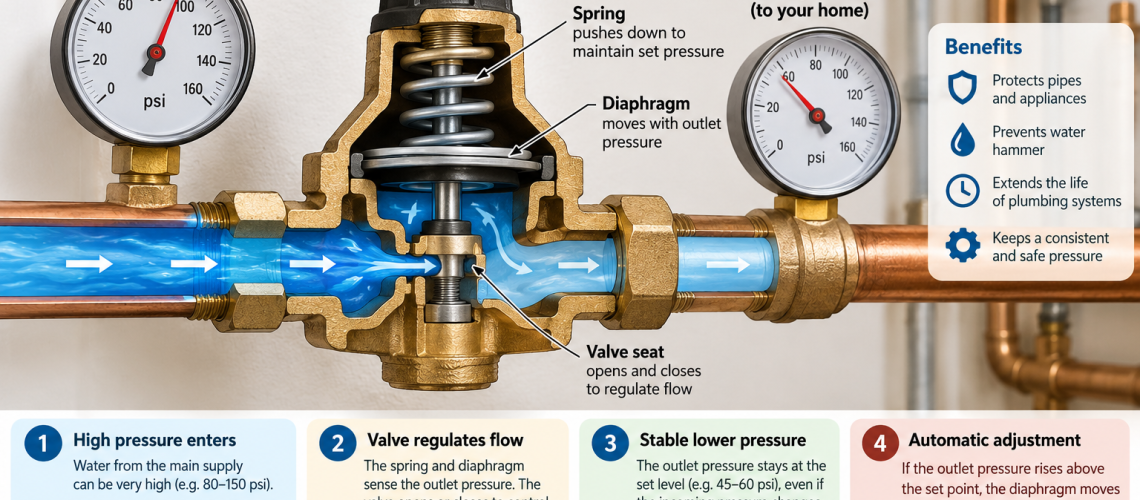

City water often arrives at a higher pressure than household plumbing is built for. In parts of Toronto and the GTA, the pressure in the street main sits well above what faucets, toilet fill valves and appliance hoses are rated for. A small brass water pressure regulator on the main line brings it down to a safe level, and most people only learn it exists when it stops working. This guide explains what the valve does, how to check it, and how to tell a worn valve from other plumbing problems that look the same.
What Is a PRV Valve?
A PRV, or pressure reducing valve, is a spring-loaded device on the main water line that lowers incoming pressure and keeps it steady. Plumbers also call it a pressure regulator. Without one, the full force of the municipal main reaches every pipe, fitting and fixture in the house.
The normal water pressure for a house is 50 to 60 psi. Fixtures and appliances are generally designed for no more than 80 psi, and constant pressure above that wears out washers, cartridges and supply hoses years ahead of schedule.
How Does a Pressure Reducing Valve Work?
Inside the bell-shaped body of a water pressure regulator there is a spring, a diaphragm and a valve seat. The spring holds it open. Water pressure on the house side pushes against the diaphragm from the other direction. As household pressure rises toward the set point, the diaphragm compresses the spring and narrows the opening. When someone opens a tap and pressure drops, the spring opens it again. All of this happens on its own, with no power or controls.
The set point is changed with an adjustment screw on top of the bell. Turning it tightens or relaxes the spring, which raises or lowers the outlet pressure.
Why a PRV Often Needs an Expansion Tank?
Most PRVs stop water from flowing back toward the city main, which turns the house plumbing into a closed system. When the water heater warms a tank of cold water, that water expands and has nowhere to go, so pressure climbs, sometimes past street pressure. An expansion tank next to the water heater absorbs the extra volume. In a house with a PRV and no working expansion tank, the relief valve on the water heater often drips after each heating cycle.
Direct-Acting and Pilot-Operated Valves
PRVs come in two basic designs. A direct-acting model uses the spring and diaphragm described above to move the seat itself, and it is what nearly every house has. A pilot-operated model uses a small control unit, the pilot, to open and close a larger main valve. That arrangement holds steady pressure at large, changing flows, so it is used where many fixtures draw water at once.
| Type | Where it is used | Strength |
|---|---|---|
| Direct-acting | Houses, townhouses, individual condo suites | Simple, compact, easy to rebuild |
| Pilot-operated | High-rise pressure zones, commercial buildings, city mains | Stable pressure at high and changing flow |
Where Is the Pressure Reducing Valve Located?
The PRV sits on the main water line right after it enters the building, usually just past the main shut-off valve and the water meter. In a Toronto house that typically means the front wall of the basement or a utility room. This is what a PRV valve looks like:
- a brass, bell-shaped fitting on a pipe the same size as the main line;
- an adjustment screw with a locknut on top of the bell;
- an arrow on the body showing the direction of flow;
- a stamped pressure range or model number.
Older homes may not have one at all. In a condo the PRV is rarely inside the suite, since the building’s PRVs sit in the mechanical room and on certain floors.

How to Tell If a PRV Valve Is Bad
The signs of a bad pressure reducing valve fall into two groups, because a failing unit usually goes one of two ways. It either stops holding pressure back, or it sticks partly closed and starves the house of water.
When pressure is too high, you may notice:
- banging pipes when a tap or the washing machine valve shuts off;
- faucets and toilets that keep dripping or running even after repairs;
- the water heater relief valve discharging;
- washing machine and dishwasher hoses bulging or failing early;
- a hissing or humming sound coming from the PRV.
When pressure is too low or unstable:
- weak flow through the whole house, not just at one fixture;
- a sharp drop when two fixtures run at once;
- shower pressure that surges and fades;
- water leaking from the body, or heavy green or white corrosion on it.
Symptoms That Can Have Other Causes
Several of these signs also come from problems that have nothing to do with the PRV. Comparing your gauge reading with the normal water pressure for a house first can save you a replacement you don’t need.
| Symptom | Points to the PRV when | Other likely cause |
|---|---|---|
| Low pressure | Every fixture in the house is affected | Clogged aerator, worn cartridge or half-closed shut-off at one fixture |
| Banging pipes | The gauge reads over 80 psi | Loose pipe straps or missing water hammer arrestors |
| Dripping faucet | Several fixtures start dripping around the same time | Worn washer or cartridge in that faucet |
| Water heater relief valve dripping | Static pressure is high | Missing or failed expansion tank, faulty relief valve |
| Temperature swings in the shower | The gauge needle swings as well | Worn shower cartridge |
If weak flow is limited to one room, the causes of low water pressure in only one bathroom are worth ruling out before anyone touches the main line.
How Long Does a PRV Valve Last?
The typical PRV valve lifespan in a home is 10 to 15 years. Hard water, sediment stirred up by work on city mains and frequent pressure surges all shorten that. Valves made fully of brass with a stainless steel strainer tend to outlast models with plastic internal parts.
Work on the city’s system is one of the less obvious triggers. Hydrant flushing and watermain repairs can send short pressure spikes and loosened sediment into house lines. The sediment collects in the inlet strainer and on the valve seat, which is why pressure problems sometimes start right after crews have worked on your street. The same spikes can make the water heater relief valve discharge, so its drain pipe should run down to a floor drain.
Clear Signs It Is Time for a Replacement
Age alone doesn’t decide when to replace a PRV valve. Plan for a new one if any of these apply:
- it is older than 10 to 15 years and gauge readings have started to drift;
- pressure stays above 80 psi after adjustment;
- the adjustment screw is seized or snaps when you turn it;
- the body leaks or is badly corroded;
- rebuild kits are no longer made for your model.
What Pressure Should a PRV Be Set At
For most houses, 50 to 60 psi gives a good shower on the top floor without straining fixtures, and there is rarely a reason to go above 70 psi. To adjust a pressure reducing valve, loosen the locknut and turn the screw clockwise to raise pressure or counterclockwise to lower it. Work in quarter turns, open a tap between each one to let the pressure settle, then check the gauge. Tighten the locknut once you reach the target.
If the reading doesn’t change at all while you turn the screw, the PRV is no longer regulating and adjustment won’t help.
Can a PRV Valve Be Repaired?
PRV valve repair is often possible. Many valves accept a rebuild kit with a new diaphragm, seat and seals, and a clogged strainer only needs cleaning. Replacement makes more sense once the body itself is damaged or the valve is near the end of its service life.
| Problem | What fixes it |
|---|---|
| Clogged inlet strainer | Cleaning the strainer |
| Pressure set too high or too low | Adjusting the screw |
| Worn diaphragm or seat, pressure creeping overnight | Rebuild kit, or a replacement if no kit is available |
| Leaking body, cracked bonnet or seized screw | Replacement |
| Valve older than 15 years | Replacement |
Both jobs require shutting off the main supply and draining the line, so PRV adjustment and repair is normally done by a licensed plumber who can also test the pressure afterward.
Pressure Reducing Valve Installation Done Right
Placement matters as much as the PRV itself. The PRV belongs on the main line just after the water meter and main shut-off, before the line branches to any fixture, so it protects the whole house. A few installation details decide whether it works properly:
- The arrow on the body must point toward the house. Installed backwards, it will not regulate and can choke the flow.
- A shut-off valve on each side lets a plumber service the PRV without draining the whole system.
- Union connections make it possible to swap the unit later without cutting pipe.
- Many residential models can sit horizontally or vertically, but the position has to match the manufacturer’s instructions.
- A gauge port or a hose bib downstream makes it easy to confirm the setting.
After installation, the plumber decides what pressure the PRV should be set at for your house, usually 50 to 60 psi, and checks it with a gauge before leaving.
Pressure Reducing Valve vs Pressure Relief Valve
The names sound almost the same and both show up on plumbing quotes, but the two valves do opposite jobs. A water pressure regulator works all the time, while a relief device only steps in when something has already gone wrong.
| Valve | Where it is | What it does | When it acts |
|---|---|---|---|
| Pressure reducing valve | Main water line | Lowers incoming city pressure | Constantly |
| Pressure relief valve | Boilers and closed heating systems | Releases water when pressure passes a safe limit | Only when the limit is exceeded |
| Temperature and pressure (T&P) valve | Top or side of the water heater | Releases water when the tank gets too hot or pressure is too high | Only when a limit is exceeded |
A shower mixing valve is a fourth valve people often confuse with these. It blends hot and cold water to hold the temperature steady, and unstable pressure from a worn PRV makes that job harder.
How PRVs Work in Condos and High-Rise Buildings
In a tall building, booster pumps push water up to the top floors. Without control, the lower floors would get far more pressure than fixtures can handle. That is why high-rises are split into pressure zones, each with its own PRV station. Many stations have two valves side by side so one can be serviced while the other keeps the zone supplied, and some suites also have their own regulator on the unit supply.
The zone PRV stations are part of the building’s common elements and are maintained by the condominium corporation. A regulator that serves only one suite may be the owner’s responsibility, depending on the declaration. When several suites on neighbouring floors report low condo water pressure at the same time, the zone valve is the likely cause, and the issue should go to property management. Zone stations are usually serviced as part of condo and high-rise plumbing maintenance during a scheduled riser shutdown.
FAQ
No. Many older homes were built without one, while houses on streets with high supply pressure usually have one near the water meter. A pressure reading at the laundry tap shows quickly whether one is needed.
The Ontario Building Code requires a pressure reducing valve where static water pressure can exceed 550 kPa, which is about 80 psi.
It lowers pressure, not the size of the pipe, so flow at 50 to 60 psi should feel normal. Weak flow usually points to a clogged strainer, a valve stuck partly closed or a restriction somewhere else in the line.
If the tank is old or waterlogged, yes. Press the air valve on top of the tank: if water comes out instead of air, the tank has failed, and a new PRV alone won’t stop the water heater relief valve from dripping.
Only up to a point. Turning the adjustment screw clockwise raises the outlet pressure, but a PRV can never deliver more than the pressure coming from the street. If the supply itself is weak, raising the setting won’t help.
No. A PRV controls how much pressure enters the house, while a backflow preventer stops used or contaminated water from flowing back into the city supply. Some PRVs block reverse flow as a side effect, but they are not approved backflow devices.
It reduces it, because lower pressure means slower water and a softer stop when a tap shuts. Banging that continues at a normal setting usually comes from quick-closing valves on the washer or dishwasher.
On a standard residential line with shut-offs on both sides, a plumber usually needs one to two hours, including testing the new setting. Older homes with seized valves or corroded pipe can take longer because the fittings around the valve also need replacing.