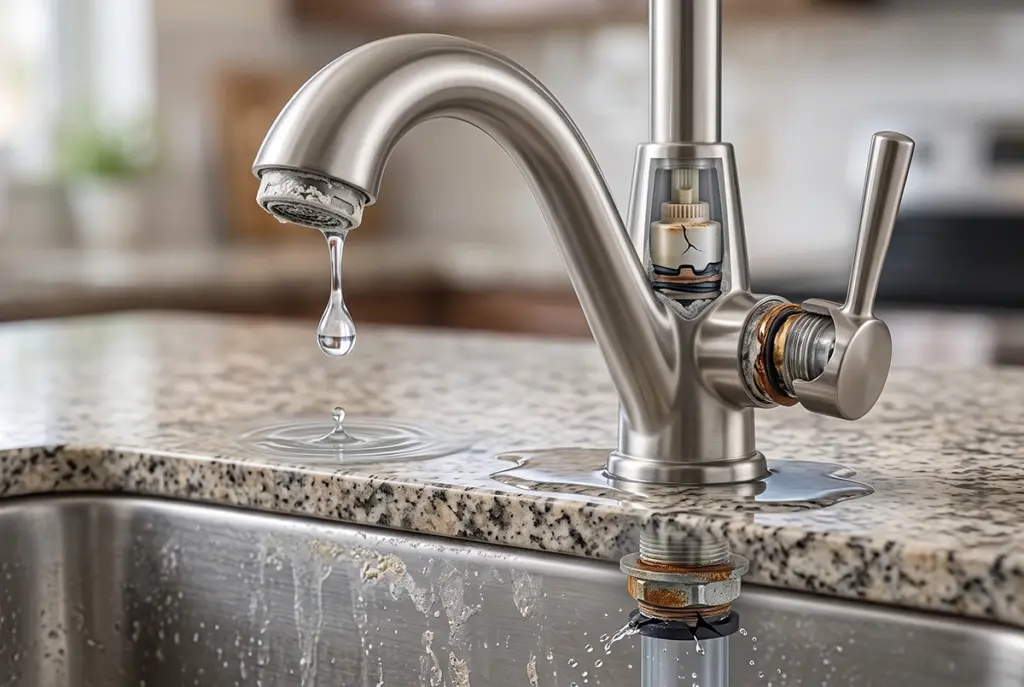


Yes. In many cases, you can repair a faucet instead of replacing the whole fixture. A leaking faucet is often caused by a worn cartridge, washer, O-ring, seal, valve seat, or loose connection – parts that may be serviceable without full fixture replacement. A full faucet replacement is usually the better choice when the faucet body is cracked or badly corroded, replacement parts are unavailable, the same problem keeps returning, or several components are failing at once.
The key is accurate leak diagnosis before buying parts or a new faucet. A repairable cartridge or seal problem can be inexpensive and quick, while replacing an aging fixture may reduce repeat labour and the risk of another leak. The sections below show how to identify the source, match the repair to the faucet design, and decide when replacement is the better long-term option.
Repair or Replace a Faucet? A Quick Decision Guide
The decision is less about whether water is visible and more about which component has failed, the condition of the faucet body, and whether compatible parts are available. Use the table as a first screening tool before taking the fixture apart.
| Situation | Repair usually makes sense | Replacement usually makes more sense |
|---|---|---|
| Single isolated drip | Washer, seal, cartridge, O-ring or seat can often be replaced | Only if the body is damaged or parts are unavailable |
| Leak around handle or base | Often repairable after confirming the exact leak source | Better if corrosion or cracks are visible in the faucet body |
| Low or uneven flow | Clean aerator, remove mineral buildup, inspect cartridge | Consider replacement if internal passages are badly corroded |
| Repeated repairs | Reasonable if the faucet is high quality and parts remain available | Usually better when the same leak returns repeatedly |
| Old or discontinued model | Repair if the correct parts are still easy to source | Replace when parts are obsolete or special-order costs are high |
| Multiple problems at once | Possible if the body is sound and a rebuild kit is available | Often more practical when the fixture is near the end of its life |
How to Repair a Leaky Faucet: Start With the Leak Location
Start by identifying where fresh water first appears. A drip from the spout, water around the handle, water around the base, and moisture under the sink can come from different components. Dry the fixture and cabinet first; replacing random parts before confirming the source wastes time and can miss a broader plumbing repair.
Faucet Leaking From Handle
When water leaks around the handle, likely causes include a worn cartridge seal, O-ring, packing component, stem seal, or loose internal connection. On a single-handle faucet, the cartridge is often the first part to inspect. On a two-handle faucet, the hot or cold stem assembly may be the source. Water can also run down the faucet body, so dry the fixture first and watch where the leak actually begins.
Faucet Leaking at Base
Water collecting at the base does not automatically mean the faucet body has failed. It may be travelling down from the handle, escaping around the spout O-rings, or coming from a supply or mounting connection below. Check both the top and underside of the sink before deciding that the fixture needs replacement.
What Causes a Leaky Faucet, and What Is the Most Common Cause of a Dripping Faucet?
The most common underlying problem is a sealing component that no longer closes fully. In modern cartridge faucets, the cartridge or its internal seals are frequent failure points. Older compression-style faucets may drip because of a worn washer, O-ring, or valve seat. Mineral buildup, debris, corrosion, and excessive water pressure can also prevent a seal from closing correctly. The exact failed part depends on the faucet design, but wear at the water-control point is the usual starting diagnosis.
Faucet Cartridge Problems: When the Cartridge Is the Real Issue
A faucet cartridge controls water flow and, in many single-handle faucets, temperature mixing. A leaky faucet cartridge can cause a persistent drip from the spout, water around the handle, stiff movement, or inconsistent hot-and-cold control. Before replacing the whole faucet, identify the manufacturer and model and confirm that the correct cartridge is available.
What Causes a Faucet Cartridge to Fail?
Common causes include normal wear, hard-water mineral buildup, grit or debris in the water supply, damaged internal seals, corrosion, and pressure or temperature stress. A ceramic disc cartridge is durable, but its polished surfaces can still be scratched by debris. Rubber seals can harden or flatten over time. Excessive water pressure can accelerate wear, and repeated early failure may point to a system issue rather than a defective replacement part.
How Do You Know If Your Faucet Cartridge Is Bad?
Signs of a bad cartridge include a faucet that continues dripping after the handle is fully closed, water leaking around the handle, a handle that is unusually stiff or loose, poor temperature control, or flow that stays weak after the aerator has been cleaned. If the faucet body and connections are dry but the spout still drips, the cartridge or valve assembly is a strong suspect.
How Long Should a Faucet Cartridge Last?
There is no universal replacement interval. Cartridge life depends on product quality, use, water chemistry, debris, installation, and water pressure. A good cartridge may work for many years, while sediment or hard water can shorten its life. Follow manufacturer guidance and replace it when symptoms appear; a cartridge that fails repeatedly should prompt a check for pressure, debris, or valve-body damage.
Repairable Parts vs. Signs the Faucet Is Done
Most faucet repairs involve small replaceable parts rather than the entire fixture. The table below shows common symptoms, the first component to inspect, the typical repair, and the signs that replacement is more practical.
| Symptom | Likely area to inspect | Typical repair | Replace the faucet when… |
|---|---|---|---|
| Drip from spout | Cartridge, washer, valve seat | Replace worn cartridge/washer or service valve seat | Body is cracked, corroded or parts are obsolete |
| Leak around handle | Cartridge seals, O-rings, stem | Replace seals, O-rings or cartridge | Leak continues after correct parts are installed |
| Leak around spout/base | Spout O-rings, mounting and supply connections | Replace seals or tighten/renew connections | Metal body itself is deteriorated |
| Weak or irregular flow | Aerator, cartridge, supply restriction | Clean aerator and inspect cartridge | Internal corrosion restricts the faucet body |
| Loose faucet | Mounting nut or bracket | Retighten or replace mounting hardware | Mounting surface or faucet shank is damaged |

How to Repair Common Replaceable Parts
- How to replace a washer in a leaky faucet: Shut off the water, remove the correct compression stem, replace the washer with the same size and material, inspect the valve seat, and reassemble without overtightening.
- How to replace an o ring on a kitchen faucet: Shut off the water, remove the handle or swivel spout as required, match the O-ring exactly, apply faucet-safe silicone grease, and reassemble without pinching the seal.
- How to fix a leaky cartridge faucet: Identify the model, note the cartridge orientation, use the exact replacement, clean debris from the valve body, and test the faucet before reinstalling the trim.
How Long Should a Faucet Last?
Many well-built kitchen and bathroom faucets last about 15 to 20 years, but that is a planning estimate rather than an automatic replacement date. Lower-quality fixtures, hard water, heavy use, poor installation, and repeated pressure stress can shorten service life. Condition matters more than age: a 12-year-old solid faucet with one worn cartridge may be worth repairing, while a newer fixture with a cracked or corroded body may need replacement.
If mineral deposits keep returning throughout the home, treating the water source can be more effective than repeatedly cleaning or replacing faucet parts. POM Plumbing offers Water Softener Installation for Toronto and GTA properties where hard-water buildup is affecting plumbing fixtures and equipment.
How to Fix a Dripping Faucet: Is It a DIY Job?
Some dripping-faucet repairs are beginner-friendly, while others become difficult because of poor access, corrosion, seized screws, hidden connections, or an unfamiliar design. The replaceable part may be small; the challenge is reaching it without damaging the handle, trim, mounting hardware, shut-off valves, or countertop. Stop if the repair requires excessive force or the water cannot be isolated reliably.
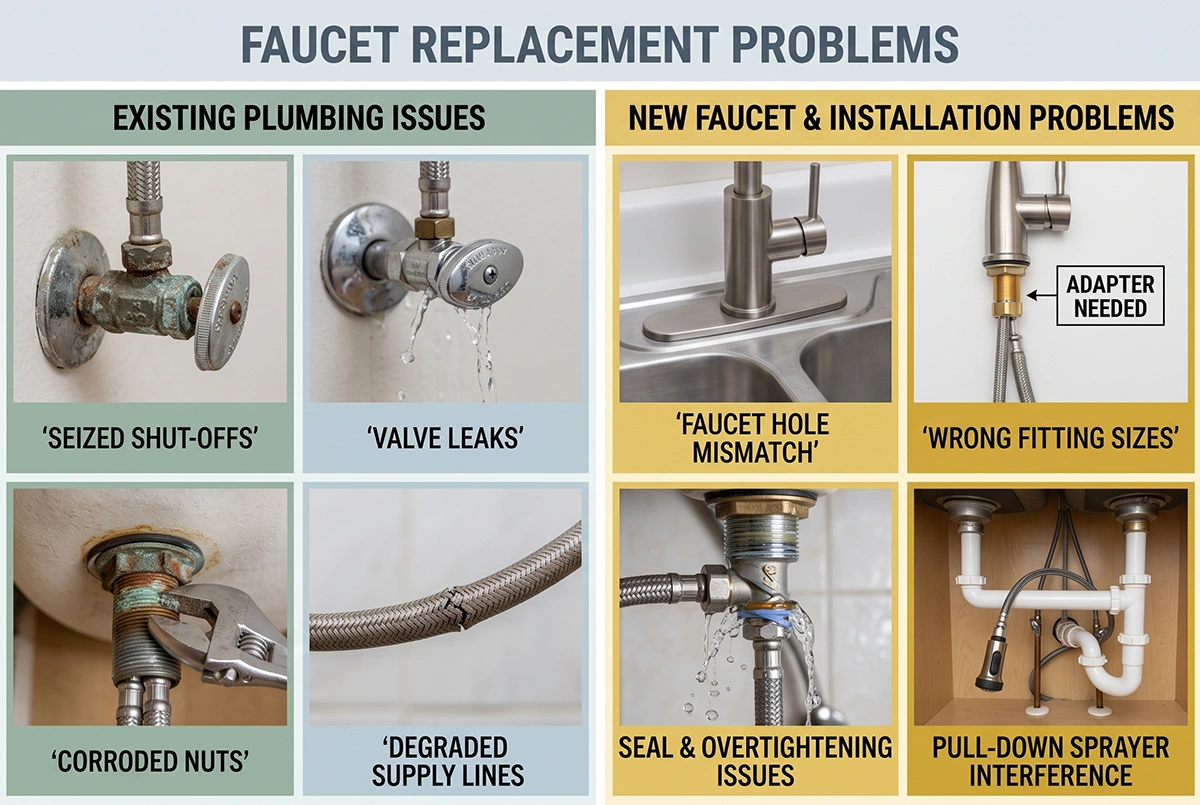
What Are Common Problems When Replacing a Faucet?
Common replacement problems are often caused by the plumbing around the faucet rather than the new fixture itself:
- Shut-off valves that are seized, leak when operated, or do not fully stop the water.
- Corroded mounting nuts that are difficult to reach or remove without cutting tools.
- Old flexible supply lines that kink, seep, or should be replaced at the same time.
- A new faucet that does not match the existing hole spacing or countertop configuration.
- Wrong connector sizes or missing adapters between the faucet and the existing supply.
- Leaks caused by twisted seals, overtightened fittings, or connections that were not rechecked under pressure.
- Pull-down sprayer hoses or weights that interfere with drain piping or cabinet contents.
When a Faucet Repair Becomes a Bigger Plumbing Job
A faucet can be perfectly repairable while the surrounding plumbing is not. Before spending money on a cartridge or a new fixture, inspect the shut-off valves, supply lines, cabinet, and accessible pipe connections. A plumber may recommend additional work when a shut-off valve cannot isolate the faucet, flexible lines are brittle or corroded, a hidden leak has damaged cabinetry, or abnormal water pressure is contributing to repeated failures.
This is also why a recurring drip should not be treated as a parts-swapping exercise. If the same cartridge fails repeatedly, the root cause may be debris, pressure, hard-water scaling, or a damaged valve body. Correcting the cause prevents the next repair from failing for the same reason.
Professional Faucet Repair in Toronto and the GTA
If the faucet body is still in good condition, professional repair can often restore it without a full replacement. POM Plumbing provides Faucet Repair for leaking, dripping, stiff, and malfunctioning fixtures across Toronto and the GTA.
When the issue is not limited to the faucet, the team can assess the surrounding shut-off valves, supply connections, water pressure, and other plumbing components as part of broader Plumbing Services. If replacement is the better option, professional faucet installation can also address aged supply lines or faulty shut-offs. If a leak is active and cannot be isolated, Emergency Plumbing Services may be appropriate to prevent water damage.
FAQ
Yes, for a standard faucet with working shut-off valves, accessible connections, and matching mounting holes. Call a plumber for leaking valves, corroded or seized fittings, or a complex installation.
Usually, yes. Deck-mounted faucets are normally disconnected and unfastened from below after the water is shut off. The sink stays in place unless limited access or seized hardware prevents safe faucet removal.
Published Toronto and GTA price guides commonly place a straightforward standard faucet installation at about CAD 200-450 for labour or basic installation, with the faucet itself often separate. The total can rise when shut-off valves need replacement, supply lines are corroded, access is tight, mounting hardware is seized, the fixture is wall-mounted or touchless, or additional plumbing modifications are required. A site-specific quote is more reliable than a flat estimate.
Plumbers generally prefer faucets that are durable, serviceable, and supported by readily available replacement parts. Solid-brass or quality stainless-steel construction, ceramic-disc cartridges, straightforward mounting hardware, and a strong parts/warranty network are usually more important than decorative features. Established brands such as Moen, Delta, and Kohler are often recommended because cartridges and service parts are widely available, but there is no single brand every plumber prefers.
Yes, if the repair involves opening the faucet, removing a cartridge, replacing a washer or O-ring, or disconnecting supply lines. Close the hot and cold shut-off valves, open the faucet to relieve pressure, and confirm that flow has stopped. If the valves do not close completely, use the appropriate upstream or main shutoff or call a plumber rather than working on a pressurized fixture.
No. Do not remove or disconnect a faucet while the water supply is pressurized. Closing the fixture shut-off valves is part of a safe replacement. If the shut-offs are missing, seized, or leaking, the water must be isolated elsewhere before the faucet is disconnected.
Sometimes mineral buildup can be cleaned, but a worn, scratched, or damaged cartridge is normally replaced rather than rebuilt. Cartridge replacement is usually more reliable than trying to restore damaged sealing surfaces.