



Kaidan Kaidan
3 months ago


Risers are the vertical pipes that carry domestic cold water, domestic hot water, hot water recirculation, and heating and cooling water to every floor of a condo or apartment building. They fail from the inside: copper thins from erosion and corrosion, joints weaken and galvanized pipe scales shut. By the time a building sees repeated pinhole leaks, the rest of that pipe is usually close behind. Original risers in Toronto towers typically last about 40 to 50 years.
POM Plumbing replaces domestic water, heating and cooling risers in occupied buildings across Toronto and the GTA. We work stack by stack so the rest of the building keeps service, protect each suite, pressure-test before walls are closed, and leave a documented system for the board's records and reserve fund study.
Supply drinking water to each suite from the booster pumps and PRV stations.
Carry hot water from the plant to fixtures, often the first to fail.
Keep hot water available instantly on every floor.
Supply and return lines for fan coils, radiators and convectors.
Chilled water lines in four-pipe systems.
Shared heating and cooling risers with seasonal changeover, or separate lines for each.
A riser replacement is a capital project, so it is planned with the board, the property manager and usually an engineer.
| Item | Typical approach |
|---|---|
| Program | Phased stack by stack in an occupied building |
| Suite water off | Hours on the suite's scheduled day, not days |
| Material | Copper (Type L) or to the engineer's specification |
| New components | Branch isolation valves, access panels, anchors, insulation, fire stopping |
| Testing | Pressure test before any wall is closed |
| Wall repair | Patched, finished and painted |
| Asbestos | Abated under containment where present |
| Records | Test records, photos and as-built notes for the board |
We start with a condition review: leak history, pipe samples or camera inspection where possible, flow and pressure readings and access conditions. The board receives a scope, phasing plan, budget and schedule, with input for the reserve fund study. Where an engineer prepares the specification and drawings, we build to it and provide our practical recommendations on materials, phasing and access first.
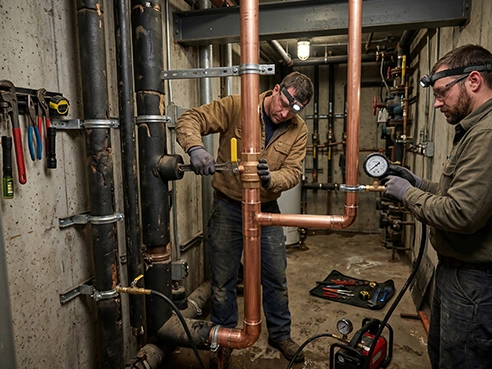
Residents stay in their homes. Each suite on a stack goes through the same steps on its scheduled day.
Riser replacement is priced per building after a condition review and scope. Budget guidance for Toronto buildings:
| Scope | Typical budget |
|---|---|
| Condition review and report | $1,500 – $6,000 |
| Single riser section repair | $2,500 – $8,000 |
| Riser replacement per stack (mid-rise) | $25,000 – $80,000 |
| Building-wide domestic riser program | quoted per building |
Each suite is usually worked on for one to three days across the stack sequence, with water off only for hours on the scheduled day. A full building-wide program in a typical Toronto high-rise runs several months, depending on the number of stacks, access, asbestos and finishes.
Why replace aging risers on a plan instead of patching leaks?
Related: riser and zone valves, Kitec replacement, PRV maintenance and condo plumbing.

With our company, you can be assured that we are fully licensed and insured to work on your plumbing and sanitation systems, providing you with the peace of mind you deserve.

We stand behind our work and offer the best warranty in the market. This means that you can be confident in our repairs, and if anything goes wrong, we'll be there to make it right.

We have over 20 years of experience in the plumbing industry, which means that we have seen it all. Our knowledge and expertise allow us to provide top-notch service to our clients every time.

We understand that plumbing repairs can be costly, which is why we offer affordable pricing without sacrificing the quality of our work. When you choose us, you can get the repairs you need at a price you can afford.
It is the replacement of the vertical water or hydronic pipes that serve each floor of a building, usually done stack by stack in an occupied building.
Usually not, as long as access has been arranged with management. Many residents choose to be home for part of the day.
Typically one to three days across the sequence for your stack, depending on access and finishes.
Hours on the suite’s scheduled day, not days. The rest of the building keeps service.
We close, finish and paint the openings as part of the project unless the contract states otherwise.
Yes. Floors, furniture and nearby finishes are covered and dust controls are used during the work.
Yes. Riser programs are designed for occupied buildings and phased stack by stack.
A typical Toronto high-rise program runs several months, depending on the number of stacks and site conditions.
Usually, yes. Full riser replacement is typically capital work planned in the reserve fund study.
Copper is the most common choice in high-rises, but the engineer’s specification may call for other approved materials.
It is abated under containment by qualified contractors with air testing and clearance before plumbing work continues.
Yes, for suites on the stacks being replaced. Access dates are scheduled in advance with written notice.
We prioritise based on leak history, pipe condition, water quality and access, and phase the remaining stacks to keep service.
Costs vary widely by building. A single riser section repair may be a few thousand dollars, while full stack replacement typically ranges from about $25,000 to $80,000 per stack in mid-rise buildings.