


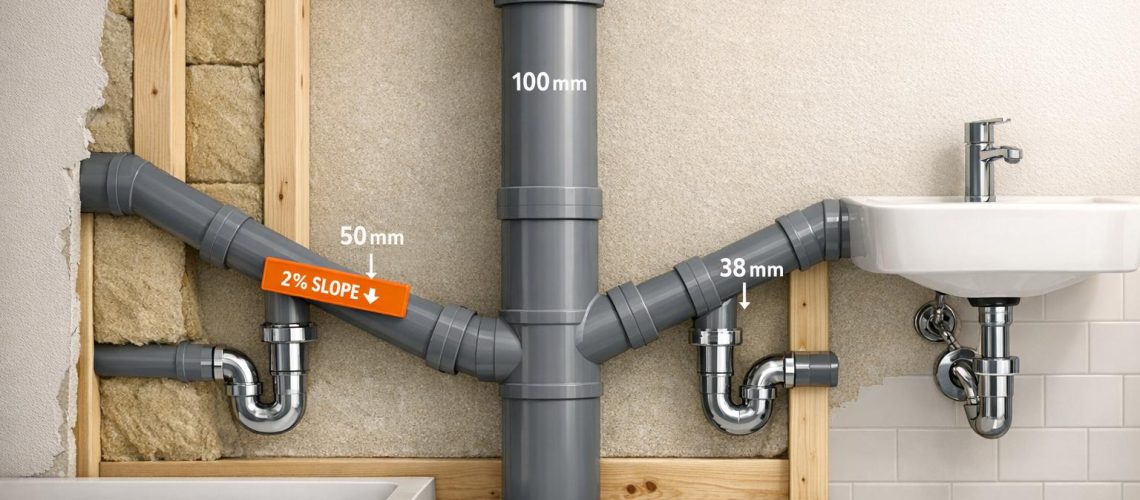

Picking the correct drain pipe size is crucial for smooth plumbing. If the pipes are too small, clogs and backups can happen. If they’re too large, solids may settle, causing blockages. Proper sizing ensures efficient drainage, prevents costly repairs, and meets Canadian plumbing codes like the National Plumbing Code and Ontario Building Code.
Key points to know:
- Standard pipe sizes vary by fixture: bathroom sinks (1.25"-1.5"), kitchen sinks (1.5"-2"), showers (2"), toilets (3"-4"), and main drains (4").
- Slopes matter: Pipes up to 3" need a 1/4" per foot slope, while 4" pipes require 1/8" per foot.
- Code compliance is mandatory in Canada to avoid fines or inspection issues.
- Measuring pipe size involves checking the nominal size or using tools like calipers for accuracy.
For large projects or complex systems, consulting a licensed plumber ensures proper installation and adherence to regulations.
Contents
- 1 Level 2 DWV – Video:1 Sizing Building Drains and Building Sewers with Tables
- 2 Why Drain Pipe Size Matters
- 3 Standard Plumbing Pipe Sizes Overview
- 4 How to Measure and Choose the Right Pipe Size
- 5 Common Problems Caused by Incorrect Pipe Sizes
- 6 Professional Plumbing Services from POM Plumbing
- 7 FAQs
- 8 Related Blog Posts
Level 2 DWV – Video:1 Sizing Building Drains and Building Sewers with Tables
sbb-itb-1e3c609
Why Drain Pipe Size Matters
Getting the right pipe size is crucial for keeping your plumbing system running smoothly and avoiding expensive repairs or potential health risks. Properly sized pipes ensure water and waste flow as they should. If pipes are too small, they can clog and back up. If they’re too large, the slower flow can cause solids to settle, leading to blockages over time.
Using pipes that are too small puts unnecessary strain on your plumbing, which can lead to early wear and even water damage. On the other hand, oversized pipes don’t maintain the velocity needed to push waste through effectively. This can result in sediment buildup and may even compromise the water seal in your drain traps. Both scenarios can lead to inefficiencies and additional stress on your system.
Experts stress how much pipe sizing affects everyday plumbing performance:
"Your sink is only as good as the drain pipe it’s attached to. If the pipe is too small, water won’t drain fast enough, and you could have plumbing problems." – Lauren Bongard, Contributing Writer, Angi
In addition to performance, regulatory standards enforce proper sizing to prevent system failures. In Canada, codes like the National Plumbing Code and Ontario Building Code require specific sizing rules. For example, a standard 3‑inch stack is designed to handle 102 Fixture Units (FUs), with a limit of 18 FUs per storey. Ignoring these rules can result in failed inspections, fines, or legal headaches when selling your home.
These regulations also aim to protect your health. Ensuring the right pipe slope – typically 1/4 inch per foot for pipes up to 3 inches – helps gravity move waste efficiently. This prevents drain traps from drying out, which is critical for blocking sewer gases from entering your home. Proper sizing and slope are about more than just compliance – they’re about safety and peace of mind.
Standard Plumbing Pipe Sizes Overview
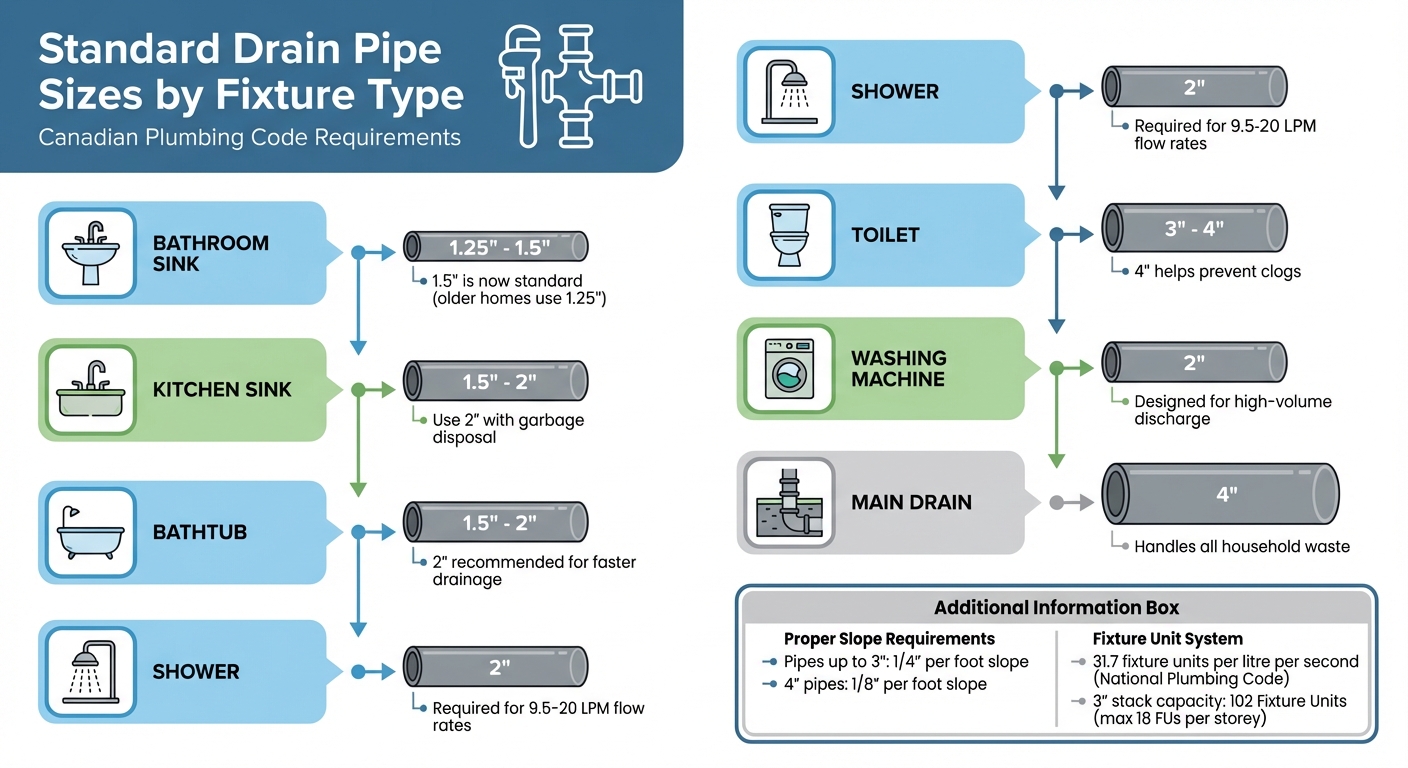
Standard Drain Pipe Sizes by Fixture Type in Canada
Choosing the right pipe size for each fixture is essential to ensure your plumbing system works efficiently. In Canada, plumbing codes rely on a "fixture unit" (FU) rating system to determine pipe diameters. This system reflects the hydraulic load a fixture places on the drainage system, factoring in water discharge volume and usage frequency. The National Plumbing Code of Canada assigns 31.7 fixture units per litre per second of flow, providing a standard for calculating the system’s total load.
Here’s a look at standard pipe sizes commonly used in Canadian homes:
| Fixture Type | Standard Pipe Size | Notes |
|---|---|---|
| Bathroom Sink | 1.25" to 1.5" | Older homes often use 1.25"; 1.5" is now standard. |
| Kitchen Sink | 1.5" to 2" | Use 2" if a garbage disposal is installed. |
| Bathtub | 1.5" to 2" | Opt for 2" for faster drainage. |
| Shower | 2" | Necessary for flow rates between 9.5–20 LPM. |
| Toilet | 3" to 4" | 3" is common; 4" helps prevent clogs. |
| Washing Machine | 2" | Designed for high-volume discharge. |
| Main Drain | 4" | Handles all household waste. |
An expert perspective supports these standards:
"The standard size for underground main sewer pipes for an average family home is 4" inside diameter" – Mister Plumber.
This size accommodates the combined load from household fixtures while maintaining proper flow velocity. For instance, a vertical 3-inch stack can handle up to six toilets, making 4-inch pipes essential for larger homes or multi-unit buildings.
Shower Drain Pipe Size
Showers require a 2-inch drain pipe to handle flow rates of 9.5 to 20 litres per minute, as per the National Plumbing Code of Canada 2020. For showers with higher flow rates – like those exceeding 20 LPM – a 3-inch pipe is recommended. Older installations with 1.5-inch pipes may suffice for low-flow showerheads but can struggle with modern, high-volume systems.
If you’re planning a luxury shower with multiple heads or rain fixtures, the 2-inch pipe is crucial to avoid water pooling or drainage issues. The larger size also reduces clogs caused by hair and soap residue.
Bathtub Drain Pipe Size
Bathtub drains typically range from 1.5 to 2 inches, with 2 inches becoming the preferred size for better water flow and faster drainage. While a 1.5-inch pipe meets minimum code requirements, choosing a 2-inch pipe is especially beneficial for larger soaking tubs or if you frequently fill the tub to capacity.
For bathtub-shower combinations, the increased water flow from shower use makes the 2-inch pipe a better option. Upgrading during renovations can help prevent slow drainage and potential overflow during heavy use.
Sink Drain Pipe Size
Bathroom sinks in older homes often use 1.25-inch pipes, but modern standards favour 1.5-inch pipes. Kitchen sinks, on the other hand, typically require 1.5 to 2-inch pipes, especially if a garbage disposal is installed.
Double sinks can complicate drainage. When two basins share a drain, a 1.5-inch pipe may struggle during peak use. Upgrading to a 2-inch pipe ensures efficient drainage and prevents backups. If your kitchen sink connects to a dishwasher, the larger pipe size becomes even more critical for smooth operation.
Toilet Drain Pipe Size
Toilets require a minimum 3-inch drain pipe for single-family homes. However, many builders use 4-inch pipes to reduce the risk of clogs. The Ontario Building Code specifies that any branch downstream of a third connected toilet must increase to 4 inches. For buildings with five to ten toilets, a 4-inch pipe is mandatory, scaling to 5 inches for 11 to 20 toilets.
How to Measure and Choose the Right Pipe Size
To figure out the size of your drain pipes, start by looking for the nominal size stamped on the pipe. This marking typically includes details like size, material, and schedule, making it easy to determine dimensions without needing any tools. If the marking is missing, you’ll need to measure the pipe manually.
For manual measurements, use digital calipers to measure the inside diameter across the pipe’s opening. If you can’t access the inside, measure the outer circumference with a flexible tape and divide that number by 3.14159 to estimate the diameter. Keep in mind that pipe sizes are based on "Nominal Pipe Size" (NPS), which doesn’t directly correspond to actual dimensions. For example, a pipe labelled as 1-inch NPS has an outside diameter of 1.315 inches.
Getting accurate measurements is key to ensuring the pipe can handle the fixture loads. For new installations, calculate the fixture unit (FU) load. Every fixture has a specific FU value: a bathroom sink is rated at 1.0 FU, a kitchen sink at 1.5 FU, and a toilet at 4.0 FU. Add up the FUs for all fixtures on the same branch line. If the total exceeds 6 FU, you’ll need to switch from a 2-inch pipe to a 3-inch pipe. According to the National Plumbing Code of Canada, semi-continuous flow systems like pumps require 31.7 fixture units per litre per second.
Proper slope is also essential for horizontal drain pipes. Pipes up to 3 inches in diameter should slope at 1/4 inch per foot, while 4-inch pipes need a slope of 1/8 inch per foot. This ensures effective gravity-fed drainage. While checking the slope, verify that all fixtures have approved P-traps installed. Older S-traps or corrugated flexible drain pipes violate the code in Ontario and should be replaced.
For major plumbing projects – like moving drains, installing new sewer lines, or any work requiring permits under the Ontario Building Code – it’s best to consult a licensed plumber. This is especially important for complex hydraulic calculations, ongoing drainage problems, or when verifying code compliance during real estate transactions.
Common Problems Caused by Incorrect Pipe Sizes
Getting the right pipe size is more than just a technical detail – it’s essential for your plumbing system to work properly. When pipes are too small, water drains slowly from sinks and tubs because the pipe simply can’t handle the volume. This often leads to clogs and backups. Toilets are particularly affected, as undersized pipes struggle to manage waste, increasing the risk of overflows.
On the flip side, oversized pipes bring a different set of headaches. When pipes are too large, water flow becomes too shallow to effectively carry away solids. This causes waste to settle, leading to gradual blockages. Plus, slow-moving water can compromise the P-trap, allowing it to dry out. When that happens, sewer gases can escape into your home – a health hazard nobody wants.
The financial consequences of these sizing mistakes can add up quickly. Frequent clogs mean higher cleaning and maintenance bills. Repairs aren’t cheap either – replacing pipes can cost between $200 and $700, while toilet repairs typically range from $200 to $400. Persistent backups can also cause water damage, further straining your plumbing system and shortening its lifespan.
There’s also a legal angle to consider. Incorrect pipe sizes can violate the Ontario Building Code, which could lead to fines or complications when selling your home. Fixing these issues later often requires expensive retrofitting – costs that could have been avoided with proper planning.
Here’s a quick comparison of the risks associated with undersized and oversized pipes:
| Problem Type | Undersized Pipes | Oversized Pipes |
|---|---|---|
| Primary Risk | Frequent clogs and overflows | Sediment buildup and sewer odours |
| Drainage | Slow drainage due to restricted capacity | Reduced flow velocity that hinders solids transport |
| P-Trap Impact | Risk of backups | Risk of siphoning dry (loss of water seal) |
| Cost Impact | High maintenance and cleaning costs | Higher initial material costs |
These challenges highlight why precise measurements and professional expertise are so critical. Proper pipe sizing isn’t just about avoiding problems – it’s about ensuring a plumbing system that works efficiently and lasts longer.
Professional Plumbing Services from POM Plumbing

When it comes to addressing drain pipe sizing issues, professional help is often essential. With more than 20 years of experience serving Toronto and the GTA, POM Plumbing ensures that every installation complies with the Ontario Building Code (OBC). Their licensed and insured technicians use advanced drain cameras for precise diagnostics, significantly reducing the risks associated with improper pipe sizing. This meticulous approach allows them to secure necessary permits efficiently and carry out installations that meet all regulatory standards.
In Ontario, meeting code requirements isn’t optional – it’s a must. POM Plumbing handles everything, from obtaining Toronto permits to ensuring full compliance with provincial regulations. Their work adheres to strict standards, such as maintaining the mandatory 1/4 inch per foot slope for horizontal drains and installing P-traps correctly to block sewer gases. For instance, one client, Trisha Grant, received a quote on a Monday, and by the following week, her backwater valve – complete with permit – was installed.
"Everything was done professional and clean. I would like to say thank you to POM Group for responding so quick to our problem." – Lidia Pasnik
POM Plumbing also stands out for its transparency. They offer upfront pricing with no hidden fees and back their services with what they describe as "the best warranty in the market". Whether you need a straightforward repair or a more complex job involving hydro jetting or trenchless technology, their comprehensive approach covers everything from diagnosis to project completion. Plus, they’re available for emergencies seven days a week, often arriving within just 15 minutes.
What really sets POM Plumbing apart is their commitment to educating customers. Their technicians take the time to explain the root cause of plumbing issues and offer tips to prevent future problems, ensuring you fully understand your system. This combination of expertise and customer focus results in reliable, code-compliant plumbing solutions that help avoid future headaches.
FAQs
Can I upsize a drain pipe to stop clogs?
Increasing the size of a drain pipe can help minimise clogs by allowing more water and waste to flow through, particularly if the existing pipe is too small for the fixture’s demands. That said, it’s important that the pipe size aligns with plumbing standards to maintain proper drainage and prevent potential problems down the line. To get it right, it’s a good idea to consult a professional plumber who can assess your system and recommend the appropriate pipe size.
When do I need a permit to change drain pipe sizes in Ontario?
In Ontario, you’ll need a permit to change drain pipe sizes if the work involves plumbing modifications connected to building construction or renovations. This requirement comes from the Ontario Building Code and local rules, like those in the City of Toronto, which outline permits for plumbing and drain-related projects.
How can I tell if my drain pipe is 1.5" or 2"?
To figure out whether your drain pipe is 1.5" or 2", start by measuring the inside diameter with a ruler or tape measure. If it measures close to 1.5 inches, it’s a 1.5" pipe; if it’s closer to 2 inches, then it’s a 2" pipe. You can also look for size markings on the pipe or fittings. Still unsure? It’s always a good idea to ask a plumber for confirmation.