


Flushable wipes aren’t safe for toilets – despite the label. Unlike toilet paper, they don’t break down in water and can cause severe plumbing issues. They form clogs in home pipes, municipal sewer systems, and even treatment plants, leading to costly repairs. Canadian taxpayers spend at least $250 million annually fixing sewer blockages caused by these wipes.
Key points to know:
- Wipes don’t disintegrate like toilet paper. They’re made with synthetic fibres that stay intact.
- Flushing wipes can lead to clogs, slow drains, and sewage backups in homes.
- Municipal systems face massive issues, including “fatbergs” and pump failures.
- Repair costs for homeowners can range from $150 to thousands, with septic system replacements costing up to $27,000.
The simplest solution? Only flush pee, poo, and toilet paper. Dispose of wipes in a trash bin or switch to a bidet for a safer, long-term fix. If you notice plumbing issues like gurgling toilets or slow drains, act quickly to avoid bigger problems.
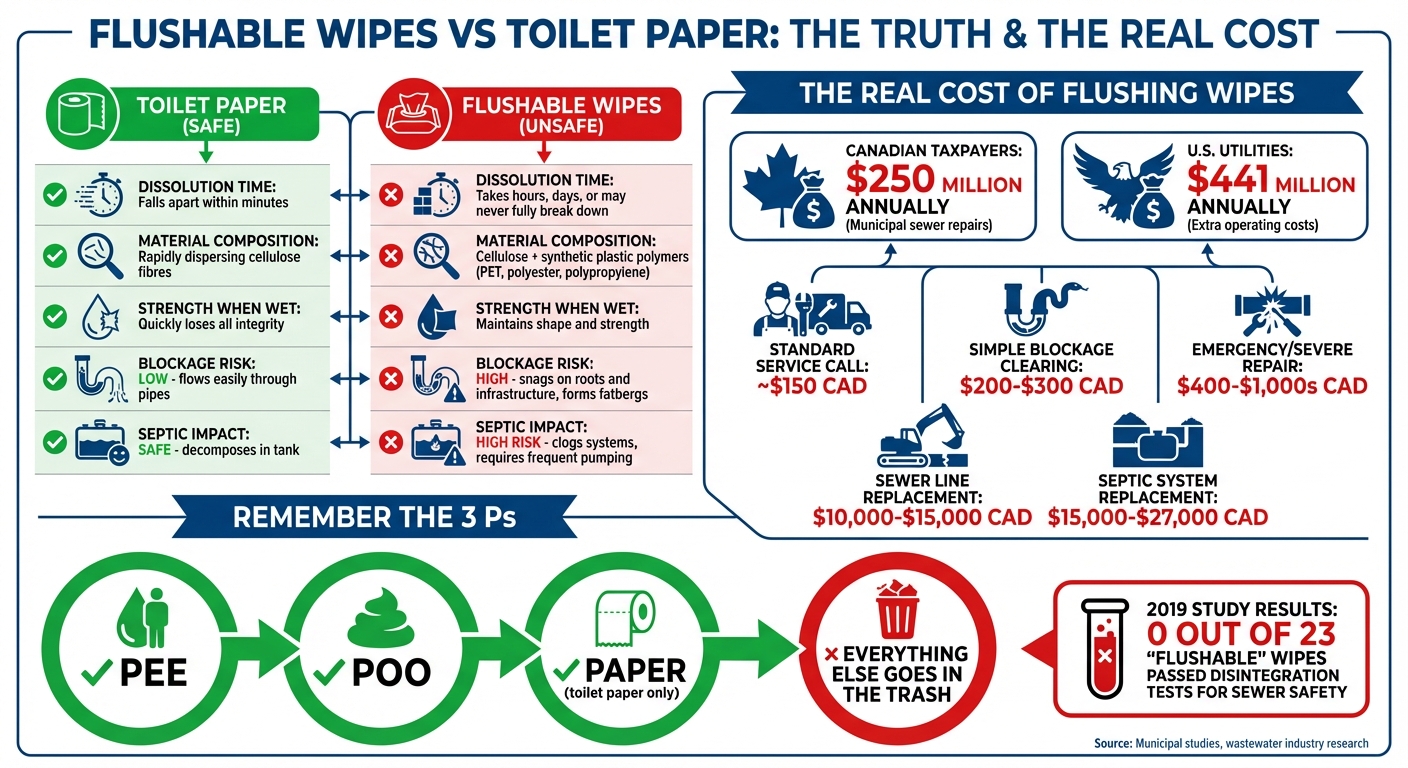
Flushable Wipes vs Toilet Paper: Breakdown Comparison and Cost Impact
Contents
- 1 Flushable Wipes – Do They Disintegrate?
- 2 How Sewer Systems Are Designed to Work
- 3 What Happens When You Flush “Flushable” Wipes
- 4 Real Plumbing Problems Caused by Flushable Wipes
- 5 Signs Flushable Wipes Are Damaging Your Plumbing
- 6 Are Any Wipes Actually Safe to Flush?
- 7 Safer Alternatives to Flushing Wipes
- 8 What to Do If You’ve Been Flushing Wipes and They Created Plumbing Problems
- 9 Conclusion
- 10 FAQs
- 11 Related Blog Posts
Flushable Wipes – Do They Disintegrate?
sbb-itb-1e3c609
How Sewer Systems Are Designed to Work
Your home’s plumbing connects to an underground network specifically designed to handle human waste and toilet paper that breaks down easily. Municipal sewer systems rely on gravity and water flow to move waste through a network of pipes, which are carefully angled and sloped for optimal efficiency. Wastewater professionals often refer to the system’s focus as the “Three Ps” – pee, poo, and paper.
Toilet paper is the only solid material these systems are built to manage because of its unique ability to disintegrate quickly into fine fibres. This rapid breakdown is crucial, as sewer pipes aren’t straight; they include sharp turns, changes in elevation, and other features that can easily trap materials that don’t dissolve.
Sewage often needs to be pumped to higher elevations during its journey. Pumps, propellers, and large screens at treatment plants help move and filter the waste. These screens catch solids before the water undergoes further treatment. When non-dissolvable items enter the system, they can snag on these components, accumulate at screens, or get stuck in older pipes with cracks or imperfections. Even a single non-dissolvable item can trigger a blockage, leading to significant issues.
“The underground system is imperfect. Grounds shift, pipes crack, and tree roots get in, so then when you have obstructions, it makes it a lot easier for wipes and other things to get caught on those and start a clog.” – Cynthia Finley, Director of Regulatory Affairs, National Association of Clean Water Agencies
These blockages not only affect your home’s plumbing but also create challenges for municipal wastewater systems.
What Happens When You Flush “Flushable” Wipes
When you flush a so-called “flushable” wipe, it doesn’t behave anything like toilet paper. These wipes are made with a mix of paper pulp and non-degradable plastic polymers like PET, polyester, or polypropylene, along with chemical additives that keep them durable even when wet. This makes them unsuitable for plumbing systems.
Unlike toilet paper, which starts breaking down almost immediately after contacting water and disintegrates within minutes, wipes hold their shape and strength as they travel through your pipes – sometimes for kilometres. Marissa Mitton, who leads Wastewater Operations and Maintenance for the City of Calgary, puts it bluntly:
“You could put it in a blender and it won’t even break down”.
As these wipes move through your plumbing, they get caught on imperfections like tree roots that have grown into cracks, low spots in the pipeline, or rough pipe connections. Once snagged, they trap other materials like fats, oils, grease, hair, and debris, forming what wastewater experts call a “fatberg” – a dense, concrete-like blockage that can grow to massive sizes.
The damage doesn’t stop at your home. In February 2026, the Arlington County Department of Environmental Services reported a major sewage overflow into the Potomac River. A clump of “flushable” wipes clogged bypass pumps during emergency repairs, leading to several hundred thousand gallons of wastewater spilling into the river. E. coli levels spiked to 14,300 per 100 millilitres as a result. Even if these wipes make it past your plumbing, they cause chaos in municipal systems – wrapping around pump propellers, clogging screens at treatment plants, and requiring manual removal by workers.
Flushable Wipes vs Toilet Paper Breakdown
Here’s a side-by-side comparison of how toilet paper and “flushable” wipes behave:
| Feature | Toilet Paper | “Flushable” Wipes |
|---|---|---|
| Dissolution Time | Falls apart within minutes | Takes hours, days, or may never fully break down |
| Material Composition | Made of rapidly dispersing cellulose fibres | Combines cellulose with synthetic plastic polymers (e.g., PET, polyester) |
| Strength When Wet | Quickly loses all integrity | Maintains shape and strength |
| Blockage Risk | Low; flows easily through pipes | High; snags on roots and infrastructure, forming fatbergs |
| Septic Impact | Safe; decomposes in the tank | High; clogs systems and demands more frequent pumping |
A 2019 study examined 101 single-use products, including 23 labelled as “flushable.” Shockingly, none of the wipes passed tests for disintegration or safe dispersal in sewer systems. One supposedly “flushable” wipe showed only 13% dispersal after an hour of agitation, far below the wastewater industry’s standard of 95%. These wipes don’t just harm plumbing – they’re a financial burden too, adding an estimated $441 million annually in extra operating costs for U.S. clean water utilities and at least $250 million per year in repairs and maintenance for Canadian municipal sewer systems.
Real Plumbing Problems Caused by Flushable Wipes
The impact of flushable wipes on plumbing systems across Canada is becoming increasingly clear. These wipes often get stuck in pipe bends and corners, where they mix with hair, grease, and other debris, forming stubborn blockages. In 2021 alone, the City of Calgary dealt with over 7,200 sewer backup calls, many of which stemmed from these clogs. For homeowners, the consequences are immediate and costly.
Residential plumbing issues often start subtly but can escalate quickly. You might notice slow-draining sinks, tubs, or toilets that gurgle when other fixtures are in use. If left unchecked, the pressure from these blockages can crack pipes, leading to leaks, ceiling stains, and even mould growth. The City of Ottawa, for example, spends over $2 million annually on repairs to blocked sewers, with flushable wipes frequently cited as a major cause.
Septic systems are no less vulnerable. Wipes can clog the leach field, causing sewage to overflow. Howard Carter, President of the Board of Trustees at the Water Environment Federation, highlights the financial burden:
“If you have your own private leach system, that replacement can cost between $15,000 and $20,000.”
The costs don’t stop there. Homeowners may face repair bills ranging from $150 CAD for minor fixes to thousands for more severe issues. On a larger scale, Canadian wastewater utilities spend at least $250 million annually addressing sewage clogs caused by wipes.
Estimated Costs for Plumbing Services in Canada
| Service Type | Estimated Cost (CAD) |
|---|---|
| Standard Plumber Service Call | ~$150 |
| Simple Blockage Clearing (Plunger/Auger) | $200–$300 |
| Emergency or Severe Repair | $400–Thousands |
| Hydro-Jetting or Sewer Pipe Replacement | Thousands |
| Septic Leach System Replacement | $20,000–$27,000 |
Flushable wipes might seem convenient, but the damage they cause to plumbing systems is anything but. Up next, you’ll find out how to spot the warning signs that these wipes might already be harming your home’s plumbing.
Signs Flushable Wipes Are Damaging Your Plumbing
Certain warning signs can indicate that so-called “flushable” wipes are wreaking havoc on your plumbing. One of the clearest indicators is a gurgling or bubbling toilet when you use a sink, shower, or flush another toilet in your home. Dave Yates, Master Plumber and Owner of Yates PHCP-PVF, describes it this way:
“The biggest ‘tell’ is a toilet bubbling when other fixtures or another toilet is flushed, as air is displaced by the rising tide.”
But that’s not the only clue. Issues with your drains and water flow can also point to trouble.
Slow or pooling drains often mean that wipes have snagged on bends or corners in your pipes, creating blockages by trapping hair, grease, and other debris. If you notice lingering bad odours coming from your drains, it could be a sign that organic waste is decomposing behind a blockage caused by wipes. Another red flag is sewage overflow at low-lying drains, such as floor drains, laundry standpipes, or basement toilets. These areas are usually the first to show signs of wastewater backup when a major clog occurs.
If you’re frequently reaching for the plunger, that’s another sign of trouble. Recurring toilet blockages suggest that wipes are accumulating in the trap or immediate drain line. In more severe cases, you might even notice visible water damage, like brown stains on ceilings or mould growth in bathrooms. This could indicate leaks or cracks caused by pressure building up in the pipes. Each of these signs points to underlying issues that can worsen if not addressed promptly.
Are Any Wipes Actually Safe to Flush?
When it comes to flushing wipes, the reality is clear: none of them are truly safe to flush. Despite what the packaging might claim, no wipe – whether labelled “flushable” or “biodegradable” – breaks down like toilet paper. Toilet paper is specifically designed to disintegrate rapidly, but wipes are made from a mix of cellulose and synthetic fibres like rayon, polyester, or polypropylene. These materials are designed to stay strong even when wet, which is exactly what causes problems in plumbing systems.
In April 2019, a study conducted by Barry Orr and Darko Joksimovic at Toronto Metropolitan University tested 101 single-use products in a controlled plumbing simulation. Among these, 23 products were labelled as “flushable.” The results? None of them met the strict disintegration standards. Only two partially broke down, while the remaining 21 stayed intact. Barry Orr, a Sewer Outreach and Control Inspector, summarised the issue bluntly:
“Wipes are kryptonite – they should not be flushed”.
Even wipes labelled “biodegradable” aren’t a safe bet. While they might break down in a compost pile over months, they don’t degrade quickly enough during their short journey through sewer systems. In fact, research shows that over half of wipes marketed as “biodegradable” and “flushable” still contain synthetic fibres that barely degrade. As Howard Carter, President of the Board of Trustees for the Water Environment Federation, explains:
“They may be biodegradable at some given time in a compost pile, but in the time they’re in the sewer system, that’s really not going to break down”.
Part of the problem lies in the testing standards used by manufacturers. Many companies follow their own “GD4” guidelines, which only require 60% of a product to pass through a sieve. In contrast, the International Water Services Flushability Group (IWSFG) demands a 95% disintegration rate to ensure safety. This discrepancy allows manufacturers to market products as “flushable” even though they fail to meet the higher standards set by wastewater professionals. The consequences are costly: Canadian municipalities spend around $250 million annually clearing blockages caused by wipes and similar materials.
All of this points to one conclusion: finding safer alternatives is critical to protecting your plumbing and preventing costly damage.
Safer Alternatives to Flushing Wipes
Avoid plumbing headaches by choosing smarter disposal methods. The simplest solution? Stop flushing wipes altogether. Marissa Mitton, Leader of Wastewater Operations and Maintenance for the City of Calgary, offers this straightforward advice:
“You should only flush the three Ps: pee, paper and poo”.
In other words, every wipe – no matter how “flushable” it claims to be – should go straight into the trash, not the toilet.
Add a lidded bin near your toilet for easy and discreet disposal of wipes and hygiene products. This small change can save you from costly plumbing repairs and help municipalities avoid expensive maintenance work. Worried about odours or appearance? A bin with a secure, tight-fitting lid will keep everything contained until garbage day.
Consider a bidet or bidet attachment as a long-term fix. Dave Yates, a Master Plumber and Owner of Yates PHCP-PVF, highlights this as a cleaner, more sustainable option:
“A better option… albeit more expensive up-front cost-wise, is installing a bidet toilet seat or a bidet”.
Though the initial cost might seem high, bidets eliminate the need for wipes entirely, reducing the risk of clogs while improving hygiene.
Stick to plain toilet paper for all bathroom needs. Unlike wipes, toilet paper breaks down in water within minutes and doesn’t contain synthetic fibres like polyester or polypropylene, which contribute to blockages. In fact, a 2019 Ryerson University study confirmed that only toilet paper properly disintegrates in sewer systems.
For high-traffic areas, such as hospitals or care facilities, install protective measures to prevent flushing issues. For example, Moffitt Cancer Center in Florida equipped its toilets with Traptex plumbing guards in 2024 after dealing with frequent sewage backups caused by wipes. According to John Raisch, Director of Facility Management, the guards were quick to install – taking less than five minutes per toilet – and reduced backups from two to three per week to just one or two per month. This change significantly lowered repair and remediation costs.
Now, let’s look at what to do if your plumbing is already suffering from these kinds of problems.
What to Do If You’ve Been Flushing Wipes and They Created Plumbing Problems
First, stop flushing wipes – throw every single one in the trash from now on.
If you’ve already been flushing them, watch for signs of plumbing trouble. These can include slow drains, water pooling around fixtures, bubbling toilets, persistent bad smells, or even visible leaks. These red flags often point to a blockage or other damage in your plumbing system, and acting quickly can help you avoid a full-blown sewer backup.
Once you notice a problem, the next step is to figure out who’s responsible for the repairs. Determine whether the issue is on your property or the City’s. In Toronto, the City owns the sewer line from the street to your property line, while you’re responsible for the section from the property line to your home. If you suspect a blockage or flooding, call 311. The City of Toronto usually sends someone to investigate within four hours. If the issue is on your side of the property line, you’ll need to hire a licensed plumber to fix it.
For professional help, contact POM Plumbing Service Company. With over 20 years of experience in Toronto and the GTA, POM Plumbing specializes in drain cleaning, CCTV sewer inspections, and emergency services to handle blockages caused by wipes. Their team can locate where the wipes are stuck, remove them (even from tricky pipe bends), and repair any related damage, such as leaks. Costs for these services usually range from $150 to $400, depending on how severe the problem is and whether it’s an emergency.
Make sure technicians can access your cleanouts. These are typically located in the basement or outside your property. If you don’t have a working cleanout, a plumber will need to install one before they can properly diagnose and fix the blockage. Ignoring the issue could lead to much bigger headaches – like needing a full sewer line replacement, which can cost anywhere from $10,000 to $15,000.
Conclusion
Sewer systems are designed to handle only three things: pee, poo, and toilet paper. Even though some packaging claims that “flushable” wipes are safe for toilets, the reality is different. Unlike toilet paper, these wipes contain synthetic fibres and plastics that don’t break down easily. Instead, they contribute to clogs and the formation of fatbergs in sewer systems.
The impact of flushing wipes is costly. Municipalities face an estimated $250 million in damages annually. For homeowners, the expenses can be even more personal – repairs for sewer lines might run between $10,000 and $15,000, while septic system fixes can reach $15,000 to $20,000. Even a basic service call can cost anywhere from $150 to $400.
To avoid these issues, always throw wipes in the trash. Using a bathroom bin for disposal or switching to a bidet can help protect your plumbing. If you’ve been flushing wipes and notice slow-draining water, gurgling sounds, or unpleasant odours, these could be signs of a developing blockage. Acting quickly and consulting a professional can prevent more serious (and expensive) problems.
If you’re already dealing with a blockage, POM Plumbing Service Company is here to help. With over 20 years of experience serving Toronto and the Greater Toronto Area, they specialize in services like drain cleaning, CCTV sewer inspections, and emergency plumbing. Whether it’s a routine cleanout or a major repair, their expertise can save you from costly damage in the long run.
Remember the 3 Ps rule: only flush pee, poo, and toilet paper. Your plumbing – and your wallet – will thank you.
FAQs
Can a few wipes really clog a sewer line?
Yes, even just a few wipes can block a sewer line. Unlike toilet paper, which dissolves quickly, wipes don’t break down easily. Instead, they can mix with other debris, forming massive blockages known as fatbergs. These clogs can cause serious plumbing issues, like sewage backups and expensive repairs. To keep your pipes safe, it’s best to avoid flushing wipes entirely – even if the packaging claims they’re ‘flushable.’
How can I tell if wipes are stuck in my pipes?
If you’re dealing with frequent clogs, backups, or notice that wipes remain intact after flushing, they might be stuck in your pipes. Unlike toilet paper, wipes don’t break down easily, making them a common cause of blockages in plumbing systems.
What should I do if my toilet backs up after flushing wipes?
If your toilet clogs after flushing wipes, resist the urge to push the blockage further down the pipe. Instead, call a professional plumber to address the issue. Even so-called “flushable” wipes don’t break down easily and can lead to serious clogs. While waiting for help, avoid flushing anything else or using chemical drain cleaners, as these can make the problem worse. To avoid future clogs, always throw wipes in the trash instead of flushing them.