



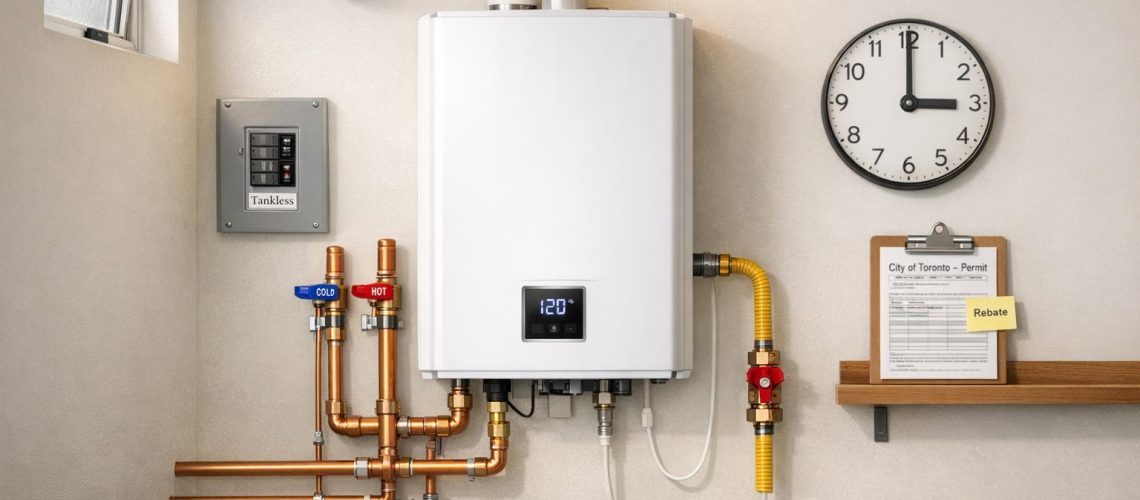

Switching to a tankless water heater in the GTA can save space, cut energy bills by up to 30%, and provide endless hot water. However, installation costs range from $2,800 to $8,500, depending on factors like gas line upgrades, venting, or electrical work. The process takes 4–6 hours for simpler setups but may extend to a full day for complex retrofits.
Key points to know:
- Costs: Gas units cost $3,440–$8,750 (including permits, labour, and upgrades), while electric units are cheaper but often require panel upgrades.
- Efficiency: Tankless systems operate at 90–98% efficiency, compared to 60–68% for tank models, saving $100–$200 annually.
- Rebates: Eligible units may qualify for up to $1,000 in rebates through Enbridge Gas or federal programs.
- Installation: Professional installation is essential to meet Ontario Building Code requirements and ensure safety.
While upfront costs are higher, the long-term savings, durability (20+ years lifespan), and convenience make tankless water heaters a smart investment for GTA homeowners, provided you weigh the pros and cons of tankless water heaters for your specific needs.
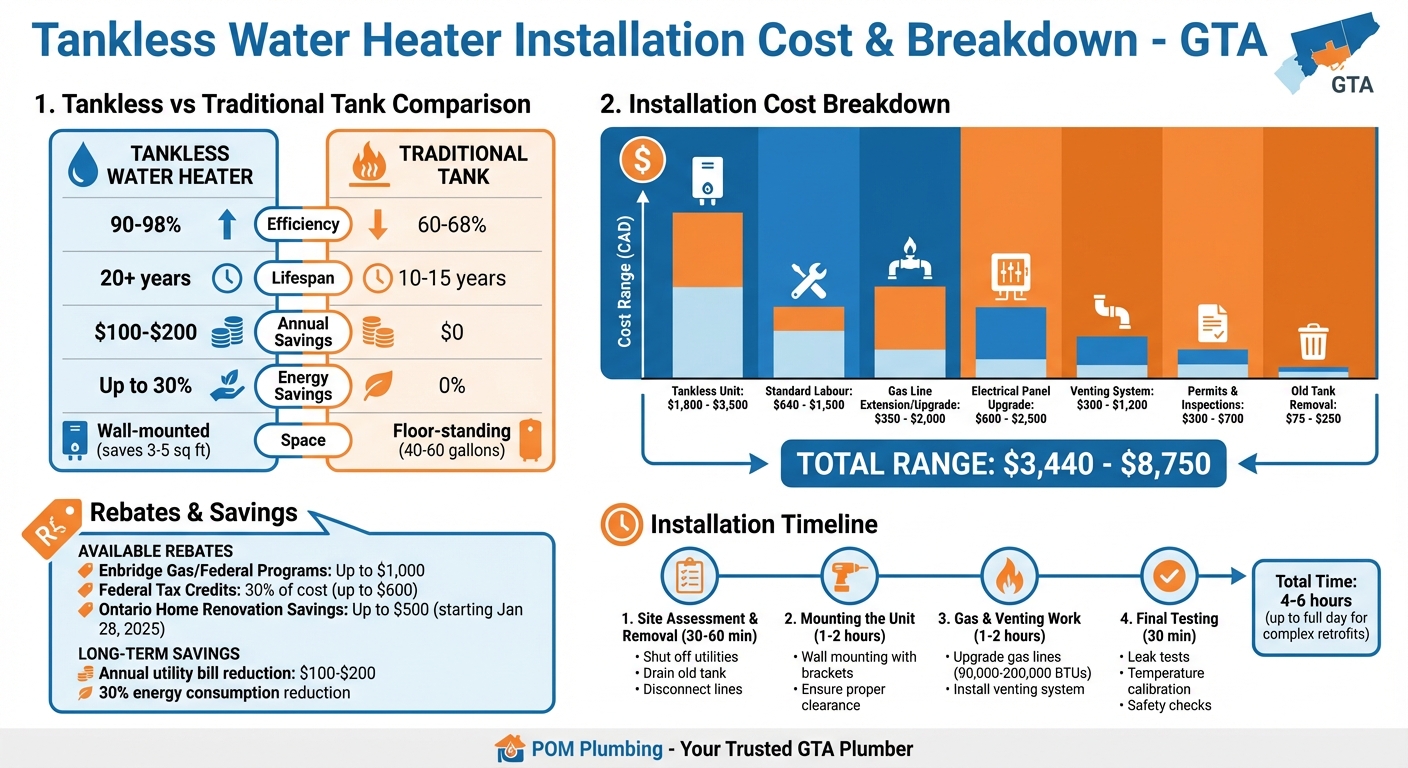
Tankless vs Tank Water Heater Cost and Installation Breakdown GTA
Contents
- 1 Step by Step Tankless Water Heater Install for Beginners!
- 2 What Is a Tankless Water Heater and When It Makes Sense in the GTA
- 3 Tankless Water Heater Installation Cost in the GTA
- 4 How Long Tankless Water Heater Installation Takes
- 5 Tankless Water Heater Installation Process
- 6 Local Installation Rules in Toronto and Ontario
- 7 Where Tankless Water Heaters Are Installed in GTA Homes
- 8 Popular Tankless Water Heater Brands in the GTA
- 9 When to Call a Licensed Tankless Water Heater Installer
- 10 Conclusion
- 11 FAQs
- 12 Related Blog Posts
Step by Step Tankless Water Heater Install for Beginners!
Once installed, regular water heater maintenance is key to keeping your new system running efficiently.
sbb-itb-1e3c609
What Is a Tankless Water Heater and When It Makes Sense in the GTA
A tankless water heater heats water instantly, only when you need it, using a high-efficiency heat exchanger. Unlike traditional systems, it doesn’t store 40–60 gallons of hot water that require constant reheating. As Airsense Mechanical puts it, "Tankless water heaters, often called on-demand water heaters, operate differently. They heat water as you need it, without storing it."
This setup eliminates the standby heat loss seen in traditional tanks, where energy is wasted keeping stored water hot. With efficiency ratings between 90–98%, tankless systems outperform conventional tanks, which typically range from 60–68%. Plus, they last longer – up to 20+ years, compared to the 10–15 years you can expect from standard tanks.
In the GTA, tankless water heaters are a smart choice for condos and urban homes. Their compact, wall-mounted design saves precious floor space. They’re also ideal for larger households with high water usage, easily handling multiple simultaneous demands like showers, laundry, and dishwashing. If you’re an energy-conscious homeowner planning to stay put for at least five years, the extended lifespan of these systems can also bring long-term savings.
One thing to keep in mind in the GTA is the colder winter groundwater temperatures, which can dip to around 7°C–13°C. To ensure a comfortable water temperature, it’s crucial to select a unit with adequate capacity. Condensing gas models with UEF ratings of 0.90–0.98 perform exceptionally well and may even qualify for rebates of up to $1,000 through Enbridge Gas or the Canada Greener Homes Initiative.
Whether you’re limited on space in a condo, managing a busy household, or looking to cut utility costs, a tankless water heater offers plenty of benefits. For GTA homeowners, understanding these advantages makes it easier to weigh the upfront installation costs against the long-term gains.
Tankless Water Heater Installation Cost in the GTA
Installing a tankless water heater in the GTA typically costs between $2,800 and $8,500. The final price depends on factors like the fuel type, retrofitting needs, and any necessary infrastructure upgrades.
One of the main cost factors is transitioning from a traditional tank system to a tankless unit. Most homes in the GTA weren’t initially designed for tankless systems, so modifications to gas lines, venting, or even electrical panels are often required. As LG Home Comfort explains:
Installing tankless water heaters in Ontario typically costs $3,000 to $5,000.
Gas tankless water heaters are more common in the GTA and tend to cost more upfront compared to electric models. Equipment costs for gas units range from $1,000 to $2,600, while electric units are generally priced between $600 and $1,500. High-efficiency condensing gas models, known for their 96–98% efficiency and eligibility for rebates, usually fall in the $1,800 to $3,500 range.
Labour costs vary depending on the complexity of the installation. For a straightforward replacement, labour fees typically range from $640 to $1,000, while converting from a traditional tank system can push costs to $1,500–$3,700. Premier Plumbing highlights another potential expense:
Many Toronto homes require electrical panel upgrades to support the 120 to 200 amp draw these units need. Panel upgrades add $1,200 to $2,500 to your total cost.
Average Price Range and What’s Included
A professional installation involves more than just the water heater itself. Costs also cover labour, upgrades, permits, and the removal of your old system. Below is a breakdown of typical expenses:
| Component | Estimated Cost (CAD) |
|---|---|
| Tankless Unit | $1,800–$3,500 |
| Standard Labour | $640–$1,500 |
| Gas Line Extension/Upgrade | $350–$2,000 |
| Electrical Panel Upgrade | $600–$2,500 |
| Venting System | $300–$1,200 |
| Permits & Inspections | $300–$700 |
| Old Tank Removal | $75–$250 |
| Total Range | $3,440–$8,750 |
Permit fees and inspections generally add $300 to $700 to the total cost.
Electric models, while avoiding venting costs, often require a dedicated electrical circuit or even a full panel upgrade, which can cost $850 to $2,500.
For homeowners in the GTA, condensing gas models provide added benefits. Although they cost more upfront, they may qualify for rebates of up to $1,000 through programs like Enbridge Gas or the Canada Greener Homes Initiative. Additionally, their higher energy efficiency can save you $100 to $200 annually on utility bills.
To save on costs, consider bundling your tankless water heater installation with other plumbing projects. This approach can reduce total labour fees by 10–20%.
Next, we’ll explore how long the installation process typically takes and what you can expect during the upgrade.
How Long Tankless Water Heater Installation Takes
Installing a tankless water heater in the GTA typically takes 4 to 6 hours, though more involved conversions can extend the process to 7 hours or even an entire day. The extra time is often needed for tasks like upgrading gas lines or adding new venting systems.
The time required depends on several factors. Switching from a traditional tank system, for example, is more labour-intensive than replacing an existing tankless unit. As Northfield Mechanical explains:
"Depending on the age and condition of your home’s utilities, the entire process can take anywhere from several hours to a full day."
In downtown Toronto condos, additional considerations like elevator wait times or limited service room access can add 1 to 2 hours to the job. Likewise, drilling through tougher materials like brick or concrete takes longer than working with wood siding.
You can help speed things up by preparing the workspace ahead of time. Clearing out clutter near the water heater, shut-off valves, and utility areas could save 30 to 60 minutes of labour, which might also save you $50 to $150. For condo residents, arranging parking and scheduling elevator access can eliminate potential delays before the work starts. Below is a breakdown of the typical installation process.
Typical Installation Time (4–6 Hours)
The installation process is generally divided into four main stages:
- Site Assessment and Removal (30–60 Minutes)
The first step involves shutting off utilities, draining the old tank, and disconnecting water, gas, and electrical lines. For a standard 40- to 60-gallon tank, draining usually takes about 30 to 60 minutes. - Mounting the Unit (1–2 Hours)
The compact tankless water heater is mounted on the wall using heavy-duty brackets, ensuring it’s properly secured and has enough clearance from combustible materials. The type of wall – drywall, brick, or concrete – affects how long this step takes, with harder materials requiring more time to drill through. - Gas and Venting Work (1–2 Hours)
Tankless systems demand high BTU outputs (90,000 to 200,000 BTUs), often requiring an upgrade from a 1/2-inch gas line to a larger one. Special venting pipes, made of stainless steel or PVC, are installed by drilling through exterior walls. If the gas meter is far from the unit, this step could take longer. Condo-specific challenges, such as logistics or wall material, can also impact timing. - Final Testing and Commissioning (About 30 Minutes)
The final stage includes performing leak tests, calibrating temperature settings, and ensuring the unit is functioning correctly. This step is crucial to ensure safety and warranty compliance.
Tankless Water Heater Installation Process
Installing a tankless water heater in the GTA involves a series of precise steps that must align with safety codes and integrate seamlessly with your home’s existing systems.
The process begins by shutting off utilities and carefully removing the old tank. The new compact tankless unit is then mounted on a sturdy wall using heavy-duty brackets, ensuring it’s securely positioned with enough clearance from combustible materials. Installers also place the unit in a location that allows for easy access, especially for routine maintenance like the annual descaling required by many manufacturers to maintain warranty coverage.
New water lines are installed next, complete with isolation valves on both the cold water inlet and hot water outlet. This setup makes it easier to flush the system during maintenance without disrupting water flow to the rest of the house. A pressure relief valve is added for safety, along with an expansion tank to manage pressure changes and comply with Ontario Building Code standards. These steps lay the groundwork for addressing the gas, venting, and electrical systems, which are critical to the unit’s operation.
During the final stages, utilities are gradually restored, and the installer performs leak tests and adjusts water pressure and temperature settings. These checks ensure the system operates efficiently and safely before the installation is finalized.
Gas Line, Venting, and Electrical Requirements
Tankless water heaters, especially natural gas models, require a significant fuel supply – typically between 90,000 and 200,000 BTUs. Many homes in the GTA are equipped with ½-inch gas lines, which often need to be upgraded to ¾-inch or even 1-inch lines to meet these demands. The installation also includes adding a shut-off valve, a sediment trap, and conducting pressure tests to confirm there are no leaks. All gas-related work must be carried out by a TSSA-certified technician, as mandated by Ontario regulations.
The venting system depends on the type of tankless unit. Non-condensing models produce high-temperature exhaust and require specialized stainless steel venting. On the other hand, high-efficiency condensing models can use PVC or CPVC piping and feature a condensate drainage system, which is usually directed to a floor drain. Most installations use a concentric venting system, with separate pipes for air intake and exhaust, designed with proper slopes to allow drainage. Note that traditional chimney flues are not suitable for tankless water heaters.
Here’s a quick summary of the main technical requirements:
| Installation Component | Technical Requirement |
|---|---|
| Gas Line | Must support 90,000–200,000 BTUs; includes shut-off valve, sediment trap, and testing |
| Venting (Non-Condensing) | Stainless steel piping to handle high-temperature exhaust |
| Venting (Condensing) | PVC or CPVC piping with condensate drainage to a floor drain |
| Electrical (Gas Units) | Standard 120V outlet for controls and ignition |
| Electrical (Electric Units) | High-amperage circuits (100–200 amps); may require panel upgrades |
Electrical requirements vary depending on the model. Gas-powered units need a standard 120V outlet for electronic controls and ignition. Whole-home electric models, however, often require 120 to 200 amps, which may necessitate upgrading older electrical panels in GTA homes. Panel upgrades can range from $1,200 to $4,000 and must meet Electrical Safety Authority standards, complete with the necessary permits.
For condensing models, an additional consideration is the acidic condensate generated during operation. This liquid needs to be routed to a floor drain or, in some cases, passed through a condensate neutralizer to protect your plumbing. Homeowners should ensure their home has an appropriate drainage solution before committing to a condensing model.
Local Installation Rules in Toronto and Ontario
If you’re planning to install a tankless water heater in the Greater Toronto Area (GTA), you’ll need to follow some strict local regulations. Every installation must comply with the Ontario Building Code and secure the necessary permits to ensure both safety and insurance coverage.
For any project that alters your home’s water supply, drainage, or venting systems, a plumbing permit is required. In Toronto, this means you’ll need a plumbing permit (starting at $205 for up to five fixtures), a gas permit for gas-fired units (ranging from $200 to $400, handled by a TSSA-certified fitter), and an electrical permit (costing between $150 and $300) for electric models or any panel upgrades.
"A plumbing permit is required for any plumbing work that alters existing systems or installs new fixtures." – Lifetime Building
Following these rules not only ensures legal compliance but also protects your investment and simplifies future property transactions. Building permits are only required if structural changes are involved, like cutting floor joists or modifying load-bearing walls to install or relocate the unit. Starting February 16, 2026, Toronto will require the updated "Application for a Permit to Construct or Demolish" form. These permits are a critical part of the process, ensuring your system is safe and meets all insurance requirements.
Permits and Ontario Building Code Basics
The Ontario Building Code provides detailed technical standards that every tankless water heater installation must meet. For gas models, proper venting is essential – condensing units can use PVC or CPVC piping, while non-condensing models require stainless steel venting to handle high-temperature exhaust. Traditional chimney flues are not allowed for these systems.
Condensing units also produce acidic condensate, which must be drained in compliance with the code. Additionally, expansion tanks are required to manage thermal pressure changes, protecting your plumbing system from damage. To prevent scalding, tempering valves are often recommended to limit the maximum water temperature.
Each permit triggers a series of inspections, including rough-in, pressure testing, and final completion. These inspections must take place before walls are closed up. Skipping permits can lead to fines, denied insurance claims, and issues when selling your property. Hiring licensed contractors simplifies the process – they handle permit applications and inspections, ensuring your installation meets all legal and safety standards.
Where Tankless Water Heaters Are Installed in GTA Homes
Basements are the go-to spot for tankless water heaters in the GTA. This makes sense because most homes already have water and gas lines running through the basement, simplifying the installation process and keeping costs down. Plus, since tankless units are mounted on walls, they save the 3–5 square feet that traditional tanks would otherwise take up.
"Tankless water heaters are small and can be installed in tight spaces, freeing up valuable square footage. This is a major advantage for Toronto’s urban homes and condos where space is premium." – Airsense Mechanical
In newer homes and condos, utility rooms and laundry closets are common choices. The wall-mounted design of tankless units fits well in these compact spaces. For gas-powered models, placement near an exterior wall is crucial because they require venting directly to the outside.
Condensing models come with an added requirement: drainage. Installing these near floor drains or existing plumbing stacks can prevent complications. If you’re considering relocating a unit, be prepared for added costs. Moving a tankless water heater can range from $800–$2,500, while attic installations can climb to $1,500–$3,500.
Outdoor installations are an option but not common in the GTA. While placing the unit outside eliminates the need for indoor venting and frees up interior space, the harsh winter climate poses challenges. Outdoor units demand freeze protection measures like heat trace cables and insulated enclosures to handle sub-zero temperatures. Because of these risks, most local installers advise keeping the unit indoors, within the home’s thermal envelope, to avoid freezing and costly repairs.
Next, we’ll take a closer look at some of the most popular tankless water heater brands in the GTA.
Popular Tankless Water Heater Brands in the GTA
When it comes to tankless water heaters, GTA homeowners often trust a handful of standout brands. Here’s a closer look at the top options available.
Navien is a go-to for Ontario’s tough winters. Known for its high-efficiency condensing technology, Navien models boast efficiency ratings of up to 98%. Their "ComfortFlow" recirculation system minimizes temperature swings, making them a reliable choice during the colder months. Units in the Navien NPE series typically cost between $1,800 and $2,600 for just the unit, while installation can bring the total to $3,200 to $4,500.
Rinnai delivers a balance of reliability and value. For mid-sized homes, the outdoor-rated V53DeN model is a solid option, priced around $1,200 to $1,500 for the unit. Larger households with multiple bathrooms might prefer the RU199iN model for its capacity and performance.
Noritz offers peace of mind with its warranty. The EZ Series comes with an impressive 25-year heat exchanger warranty, far surpassing the coverage offered by traditional tank water heaters.
For homes or condos without access to gas lines, Stiebel Eltron‘s electric models are a practical alternative. The Tempra 36, for instance, features self-modulating technology to optimize energy use. However, if electrical panel upgrades are needed, you can expect installation costs to range from $2,800 to $3,800.
Energy rebates can make these systems more affordable. Ontario’s Energy Savings Rebate Program offers up to $1,000 off ENERGY STAR–certified condensing units at participating retailers. Additionally, federal tax credits can cover 30% of the cost – up to $600 – for eligible gas models. Starting January 28, 2025, the Ontario Home Renovation Savings Program will provide up to $500 for heat pump water heaters.
"Navien condensing tankless models have efficiency ratings up to 0.96 Uniform Energy Factor (UEF)." – For Saving Home Service Inc.
To maximize rebates, choose an ENERGY STAR–certified model and ensure installation is handled by a TSSA-licensed technician, as this is often a requirement for provincial incentive programs.
Up next, we’ll discuss when to call in a licensed installer for your system upgrade.
When to Call a Licensed Tankless Water Heater Installer
Installing a tankless water heater is not a task for amateurs. The complexities involved – like upgrading gas lines, ensuring proper venting, and handling high-amperage electrical systems – go far beyond the scope of most DIY projects. Gas-powered units often need larger gas lines and strict safety measures, while electric models may require upgrades to your electrical panel to handle the increased power demand. These challenges make professional installation not just recommended but essential.
Professional installation also protects your warranty and ensures your home’s safety. Many manufacturers will void their warranty if the unit isn’t installed by a licensed professional. Beyond that, incorrect installation can lead to serious risks, such as gas leaks, carbon monoxide exposure from improper venting, or electrical fires caused by faulty wiring. To meet Ontario Building Code requirements and adhere to safety standards, licensed professionals ensure your system complies with TSSA regulations and local bylaws.
At POM Plumbing Service Company, we bring over two decades of expertise to tankless water heater installations across the GTA. Our fully licensed and insured team takes care of everything, from securing permits – starting at $205 for basic plumbing permits in Toronto – to performing TSSA-certified gas line work and ESA-compliant electrical upgrades. We proudly serve Toronto, Mississauga, Brampton, Vaughan, Oakville, and nearby areas, offering 24/7 emergency services for your convenience.
Before hiring an installer, verify their credentials. Make sure they are TSSA-certified and hold the necessary licences. They should also carry WSIB and liability insurance to protect your property during the installation process. Ensure that your contractor obtains all required permits – whether for plumbing, gas, or electrical work – so the installation passes inspection and remains covered by insurance. Finally, confirm that all technical work, from gas connections to electrical modifications, is performed by qualified professionals, following the steps outlined in our installation process.
Conclusion
Tankless water heaters offer GTA homeowners an endless supply of hot water, reduced energy consumption, and long-term cost savings. With efficiency ratings of 90% to 98% compared to the 60% to 68% range of traditional tanks, these systems can cut energy use by as much as 30%, translating to annual savings of approximately $100 to $200 on utility bills. Their compact, wall-mounted design saves precious floor space, and their lifespan of over 20 years ensures durability and reliability.
However, it’s important to consider the upfront costs and installation process. Typical installations in the GTA range from $2,800 to $4,800, while high-end natural gas condensing models can cost between $5,200 and $8,500, especially when gas line or electrical upgrades are needed. Installation usually takes 4 to 6 hours, but more complex setups, such as fuel conversions or structural adjustments, may extend the timeline to a full day.
Professional installation is essential for several reasons. It ensures compliance with Ontario Building Code standards, protects your manufacturer warranty, and can make you eligible for energy rebates of up to $1,000. Additionally, professional installers eliminate safety risks like carbon monoxide leaks from improper venting and electrical hazards.
At POM Plumbing Service Company, we’ve been serving Toronto, Mississauga, Brampton, Vaughan, and Oakville for over 20 years. Our licensed and insured team handles every aspect of tankless water heater installation, from securing permits (around $205 in Toronto) to TSSA-certified gas work and electrical upgrades. Reach out to us anytime – our team is available 24/7 for consultations and emergency services.
FAQs
Will a tankless unit keep up in GTA winters?
A tankless water heater that’s correctly sized, installed, and maintained can handle the challenges of GTA winters. While the colder incoming water does require a greater temperature increase, models with adequate BTU capacity and proper venting are built to manage these demands. Routine maintenance is key to keeping the unit running efficiently during the colder months.
Do I need a gas line or electrical upgrade?
If you’re planning to install a gas tankless water heater, you might need to upgrade your gas line. Most often, this involves moving from a 1/2-inch line to a 1-inch line to handle the higher BTU demands. For electric models, modifications to your electrical system could also be necessary, especially for more intricate setups. It’s always a good idea to consult a licensed professional to evaluate your specific needs.
What maintenance will I need each year?
To keep your tankless water heater working efficiently, it’s important to flush it once a year. This helps remove any mineral buildup or sediment that can accumulate over time. Also, make sure to clean the filters and valves regularly. These simple maintenance steps can help your system run smoothly and extend its lifespan.
