


Canadians use 335 litres of water per person daily – double that of Europeans. This high consumption, combined with aging infrastructure and climate change, has led to a growing water crisis. Plumbing solutions can reduce waste, lower bills, and protect ecosystems. Here’s how:
- Fix Leaks: A leaking toilet can waste up to 200,000 litres yearly. Simple checks save water and money.
- Low-Flow Fixtures: Faucets, showerheads, and dual-flush toilets cut water use by 40–67%.
- Smart Tech: Motion-activated taps and leak detectors prevent waste and costly damage.
- Greywater Systems: Reuse water from sinks and showers for toilets or irrigation.
- Preventive Maintenance: Regular inspections prevent leaks and prolong system life.
Upgrading to water-efficient plumbing pays off by cutting water bills and reducing energy use for heating. Small changes lead to big savings for households and the planet.
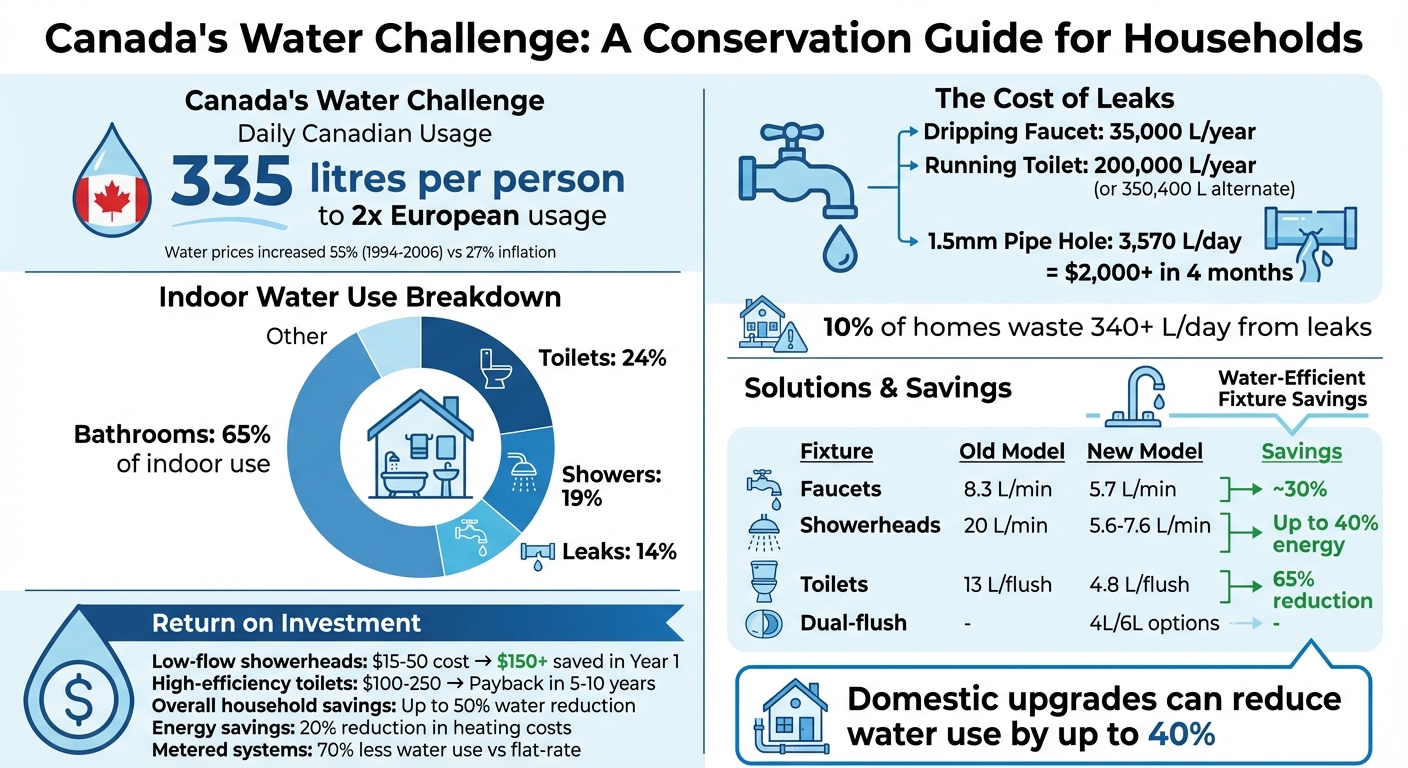
Canadian Water Conservation Statistics and Savings Guide
How to Choose Water Saving Plumbing Fixtures | Ask This Old House

Why Water Conservation Matters in Canada
Canada might be known for its abundant freshwater, but the reality is more complicated. The country is facing a recognized water crisis. Many communities struggle to access safe drinking water, and outdated infrastructure hampers the treatment and delivery of this vital resource. Unlike some other nations, Canada can’t simply tap into new water sources on demand. Protecting what we already have through conservation is absolutely necessary.
The environmental stakes are enormous. Cutting back on water use at home reduces the amount of wastewater that ends up in rivers and lakes, lowering the risk of contamination. Beyond that, conservation ensures there’s enough water left in rivers and reservoirs to support aquatic ecosystems. With climate change ushering in more frequent droughts and extended dry periods, these efforts are becoming essential. This is where modern plumbing solutions and other conservation tools can play a big role.
But it’s not just about the environment – there’s a financial side too. Water isn’t cheap. Between 1994 and 2006, water prices in Canada shot up by 55%, far outpacing the economy-wide inflation rate of 27% over the same period. In 2006 alone, local governments spent more than $4.5 billion to purify and supply water. The City of Ottawa highlights why:
The process of turning water into safe drinking water costs money due to the sophisticated processes, infrastructure, facilities, and chemical and electrical costs required to deliver this valuable product.
By using water more wisely, municipalities can delay or even avoid the need for costly infrastructure upgrades, sparing residents from higher taxes and utility bills. On a personal level, small changes make a big difference. Domestic upgrades can slash water use by up to 40%. And when Canadians pay for water by volume through metered systems, they use 70% less water compared to those on flat-rate plans. It’s proof that awareness and accountability drive change.
The bathroom is where most of the action happens – 65% of indoor water use in Canadian homes comes from this space. Toilets alone account for 24%, while showers make up 19%. Even small inefficiencies can add up fast. Household leaks, for instance, account for 14% of indoor water use. A single dripping faucet can waste over 35,000 litres of water in a year. Upgrading fixtures and keeping up with maintenance isn’t just good for the planet – it’s good for your wallet too.
Plumbing Solutions That Conserve Water
Water conservation is becoming increasingly important in Canadian homes, and modern plumbing solutions offer practical ways to make a difference. By upgrading to water-saving fixtures, households can significantly cut down on waste and enjoy lower utility bills. On average, Canadians use 223 litres of water per person per day. Here’s how specific upgrades can help reduce this number without compromising comfort or performance.
Low-Flow Faucets and Aerators
Aerators are a simple yet effective way to save water. These small devices attach to your faucet, mixing air into the water stream. This maintains the sensation of strong water pressure while reducing the actual flow. High-efficiency faucets typically use a maximum of 5.7 L/min, compared to older models that can exceed 8.3 L/min. Many municipalities even provide aerators for free as part of conservation initiatives.
If replacing an entire faucet isn’t feasible, retrofitting with a 1.9 L/min (0.5 gpm) aerator is an easy fix that delivers immediate savings. Don’t forget to inspect and clean your aerators annually to prevent sediment buildup, which can affect their performance.
Water-Efficient Showerheads
Showers are responsible for about 19% of indoor water use. Older showerheads can use as much as 20 L/min, but modern high-efficiency models cut this down to between 5.6 and 7.6 L/min. This not only reduces water use but also lowers heating costs by up to 40%.
When choosing a water-efficient showerhead, you’ll find two main types: aerating models, which mix air with water for a mist-like spray, and laminar flow models, which create individual streams for a rainfall effect. Look for the WaterSense label to ensure the product meets both efficiency and performance standards.
Dual-Flush and High-Efficiency Toilets
Toilets are the biggest water users in most homes, accounting for 24% of indoor water consumption. Older models can use up to 13 litres per flush, but high-efficiency toilets reduce this to 4.8 litres or less. Dual-flush toilets take it a step further, offering two flush options – typically 4 litres for liquid waste and 6 litres for solid waste.
“Dual flush toilets can cut down your water usage to four litres for a light flush and six litres for a heavy flush.”
- Andrew Tucker, Waterwise
When shopping for a new toilet, check the Maximum Performance (MaP) rating to ensure it effectively handles waste under everyday conditions. Modern high-efficiency models are designed to work with standard drainpipes, reducing the risk of clogs. Reliable options are available in the $100 to $250 range.
Smart Plumbing Fixtures and Sensors
Smart technology is revolutionizing how we manage water at home. Motion-activated faucets, for example, use infrared sensors to ensure water flows only when your hands are under the tap, reducing waste. Similarly, smart leak detectors monitor your plumbing system in real time, sending alerts to your smartphone if they detect unusual activity. Some systems even include automatic shut-off valves to prevent damage from leaks.
“Smart water meters… allow you to track water usage in real time, helping detect leaks and identify high consumption areas within your home.”
- Kiva Bottero, Director, Green Building Canada
Smart showerheads are also gaining popularity. Some models use proximity sensors to lower water pressure when you step away, while others notify you when the water reaches your preferred temperature, helping to reduce waste while waiting for the shower to heat up.
Greywater Recycling Systems
Greywater systems take wastewater from showers, sinks, and washing machines, filter it, and reuse it for tasks like toilet flushing or outdoor irrigation. These systems are particularly useful in areas with water restrictions or drought conditions. While the initial cost is higher than that of individual fixture upgrades, greywater recycling can lead to long-term savings and a significant reduction in household water use.
Leak Detection and Repair
While installing water-saving fixtures is a great step, catching leaks early is just as important for conserving water. Small leaks can add up fast. Did you know that household leaks make up about 14% of all indoor water use? And roughly 10% of homes have leaks wasting more than 340 litres of water every single day. A continuously running toilet alone can waste between 20 and 40 litres per hour, adding up to a staggering 350,400 litres annually. Even a tiny 1.5mm hole in a pipe can lead to 3,570 litres wasted in just 24 hours, which could cost you over $2,000 in just four months.
The good news? Many leaks are easy to find and fix. Start by checking your water meter when all taps and appliances are turned off. Look for the low-flow indicator – a small red or black triangle, gear, or “+” sign. If it’s moving, you’ve got a leak. Toilets are another common culprit. Add some food colouring to the tank, wait 15 minutes, and see if the colour appears in the bowl. If it does, the flapper valve likely needs replacing. Faucet drips? Those are often caused by worn washers or O‑rings, which are cheap and simple to replace.
Fixing leaks isn’t just about saving water – it’s about saving money, too. For leaks that are harder to detect, smart leak detectors can be a game-changer. These devices monitor your plumbing system around the clock and send real-time alerts to your smartphone when they detect unusual water flow. Some even come with automatic shut-off valves to stop water immediately, preventing major damage from hidden leaks or burst pipes. While traditional methods like visual checks and meter monitoring are free and effective, they require consistent effort. Smart systems, on the other hand, work continuously without any input from you, offering peace of mind and long-term savings.
Traditional vs. Smart Leak Detection Methods
Here’s a quick comparison of traditional and smart leak detection approaches:
| Method | Water Savings Potential |
|---|---|
| Traditional Leak Detection | Moderate |
| Smart Leak Detectors | High |
Traditional methods – like dye tests, visual inspections, and manually checking your water meter – can work well if you stay on top of them. But they rely on you remembering to check regularly. Smart leak detectors, by contrast, provide real-time monitoring and instant alerts, helping you catch leaks before they cause serious damage. While smart systems come with a higher upfront cost, they often pay for themselves by preventing water waste and avoiding expensive repairs.
sbb-itb-1e3c609
Preventive Plumbing Maintenance for Water Efficiency
Preventive maintenance is the next step after leak detection to keep your plumbing system running efficiently. Regular upkeep not only prevents leaks but also helps avoid costly repairs down the line. Experts suggest a comprehensive plumbing inspection every two years to catch issues like pipe cracks, corrosion, and drain damage before they escalate into bigger problems. Along with these professional check-ups, simple routine tasks can go a long way in maintaining a leak-free and efficient system.
Here are a few key tasks to include in your schedule:
- Every six months: Perform a toilet dye test to catch silent leaks, and check your water meter for any hidden leaks in service lines.
- Annually: Clean faucet aerators to avoid mineral buildup, inspect water pressure to prevent pipe stress, and flush your water heater to remove sediment.
- Seasonally: Check irrigation systems in the spring and inspect washing machine hoses, upgrading to stainless-steel braided options if needed.
Monitoring water pressure is especially important. Use a pressure gauge to ensure levels aren’t too high, as excessive pressure can strain pipes and joints, leading to leaks or even bursts.
Don’t overlook larger system components either. For example, a yearly flush of your water heater can prevent sediment buildup, extending its lifespan. Similarly, inspecting appliances like washing machines and irrigation systems can help you spot wear and tear early, saving you from unexpected breakdowns.
| Maintenance Task | Recommended Frequency | Primary Benefit |
|---|---|---|
| Toilet Dye Test | Every 6 months | Detects silent leaks wasting up to 40L/hour |
| Water Meter Check | Every 6 months | Identifies hidden leaks in service lines |
| Aerator Cleaning | Annually | Maintains flow and prevents calcium buildup |
| Water Heater Flush | Annually | Prevents sediment buildup and extends lifespan |
| Pipe Inspection | Every 2 years | Prevents catastrophic bursts and water damage |
Cost Savings and Return on Investment
Beyond the ecological and practical perks of water conservation, it’s worth diving into the financial benefits – both in terms of savings and the return on investment.
Switching to water-efficient plumbing fixtures can lead to noticeable reductions in both water and energy bills. For example, cutting back on water usage also means using less energy to heat water, which can lower monthly energy costs by about 20%. Many water-saving upgrades are budget-friendly DIY plumbing fixes in the long run, with energy savings and a payback period ranging from 2 to 4 years making them a smart investment.
Take high-efficiency fixtures, for instance – they can slash household water use by as much as 50%. If you add metered systems, they encourage even more savings by motivating users to monitor and reduce their consumption. When combined with leak detection tools and regular maintenance, these upgrades not only boost immediate savings but also enhance the long-term value of the property.
The return on investment varies depending on the fixture. Low-flow showerheads, which cost between $15 and $50, can save over $150 in utility bills within their first year by reducing both water and energy use. On the other hand, high-efficiency toilets, priced anywhere from $100 to over $1,000, typically take between 5 and 10 years to pay for themselves. Showerheads tend to recoup their cost faster because they impact both water and energy consumption.
Additionally, water-efficient upgrades can make a property more appealing and valuable over time. In provinces like Ontario and British Columbia, where building codes now require high-efficiency fixtures for new builds and renovations, homes outfitted with these upgrades stand out to buyers. These forward-thinking fixtures not only offer ongoing savings but also align with modern standards, making them a solid choice for homeowners looking to add both immediate and long-term value.
Conclusion
Water conservation is both a responsibility and a practical choice for Canadian property owners. Simple upgrades, like installing low-flow toilets that cut water use by up to 65%, or smart leak detectors that prevent thousands of litres of water from being wasted annually, can make a big difference. These plumbing solutions not only reduce your water consumption but also lower utility bills and increase the value of your property.
For example, greywater recycling systems can cut household water use by nearly 50%, while also reducing the energy needed for heating and pumping water. Even small changes, like replacing older fixtures, can lead to noticeable savings on your monthly expenses.
Regulations are also driving the shift toward water-efficient plumbing. As Kiva Bottero, Director of Green Building Canada, explains:
Sustainable plumbing is not just a nice thing to do for the environment – it’s becoming essential.
In some provinces, such as British Columbia, high-efficiency fixtures are now mandatory for new construction projects. This ensures that adopting sustainable plumbing practices not only protects the environment but also aligns with legal standards.
For more complex systems like greywater recycling or smart leak detection, professional installation is key. This not only ensures compliance with local regulations but also guarantees the best long-term performance. Companies like POM Plumbing Service, with over 20 years of experience in Toronto and the GTA, specialize in delivering these advanced solutions.
Whether you’re upgrading a single fixture or adopting a more comprehensive approach, water-efficient plumbing offers a clear path to lower bills and increased property value. By investing in modern, expertly installed systems, Canadian property owners can enjoy the dual benefits of environmental responsibility and long-term savings.
FAQs
How do low-flow plumbing fixtures help conserve water and lower costs?
Low-flow plumbing fixtures are built to cut down on water usage while maintaining effective performance. They achieve this with features like flow restrictors, aerators, and dual-flush systems, which control the amount of water used per minute or per flush.
Using less water doesn’t just help conserve this essential resource – it also reduces your monthly water bills. Over time, the money saved on utilities can balance out the upfront cost, making these fixtures an environmentally conscious and budget-friendly option for households across Canada.
How does smart technology help conserve water in Canadian homes?
Smart technology is changing the way we manage water at home, making it easier to save both water and money. Take smart leak detectors, for instance – they can spot leaks right away, helping prevent wasted water and potential damage. Some even go a step further by automatically shutting off the water supply if they detect something unusual.
Then there are smart fixtures like sensor-activated faucets and dual-flush toilets. These gadgets use automation to cut down on unnecessary water use. Many can even connect to home systems, allowing you to monitor and control them remotely. By adopting these technologies, Canadian homeowners can reduce water usage, lower utility bills, and do their part to protect the environment.
Why is water conservation important in Canada, even with its vast freshwater resources?
Canada is lucky to have around 7% of the world’s renewable freshwater, but much of it is tied up in lakes, rivers, and aquifers that need careful oversight. Managing these resources wisely is crucial, especially as demands from industries, agriculture, and households continue to rise. Some areas in Canada also face unique hurdles, like droughts or unpredictable weather patterns, which can put extra pressure on local water supplies.
Saving water isn’t just about preserving resources – it also cuts down on the energy required for treatment, pumping, and heating. This, in turn, helps reduce greenhouse gas emissions and lowers utility bills. Small changes can make a big difference: installing low-flow toilets, water-efficient showerheads, or smart leak detectors can significantly reduce water usage while saving money. By being mindful of water use, Canadians can help safeguard this essential resource for future generations and contribute to a healthier environment.