



Copper pipes turn green due to a natural chemical reaction with oxygen, moisture, and carbon dioxide, forming a green layer called verdigris. This is usually harmless and even protective in 85% of cases, but the remaining 15% can signal internal corrosion or leaks, which may lead to costly damage if ignored. Key causes include:
- High humidity and condensation: Traps moisture, speeding up oxidation.
- Water leaks: Localized green buildup, often with white deposits.
- Water chemistry: Acidic or high-chlorine water can corrode pipes internally.
- Aging systems: Pipes over 30 years old are more prone to corrosion.
- Improper installation: Residue from soldering or contact with damp materials.
Most green discolouration is cosmetic, but signs like damp green spots, green-tinted water, or mineral buildup need immediate attention. Regular inspections, controlling moisture, and testing water quality can help prevent issues. If problems persist, consult a professional plumber, especially for older systems or severe corrosion.
How to Stop Copper Pipe Corrosion | Ask This Old House

sbb-itb-1e3c609
Why Do Copper Pipes Turn Green?
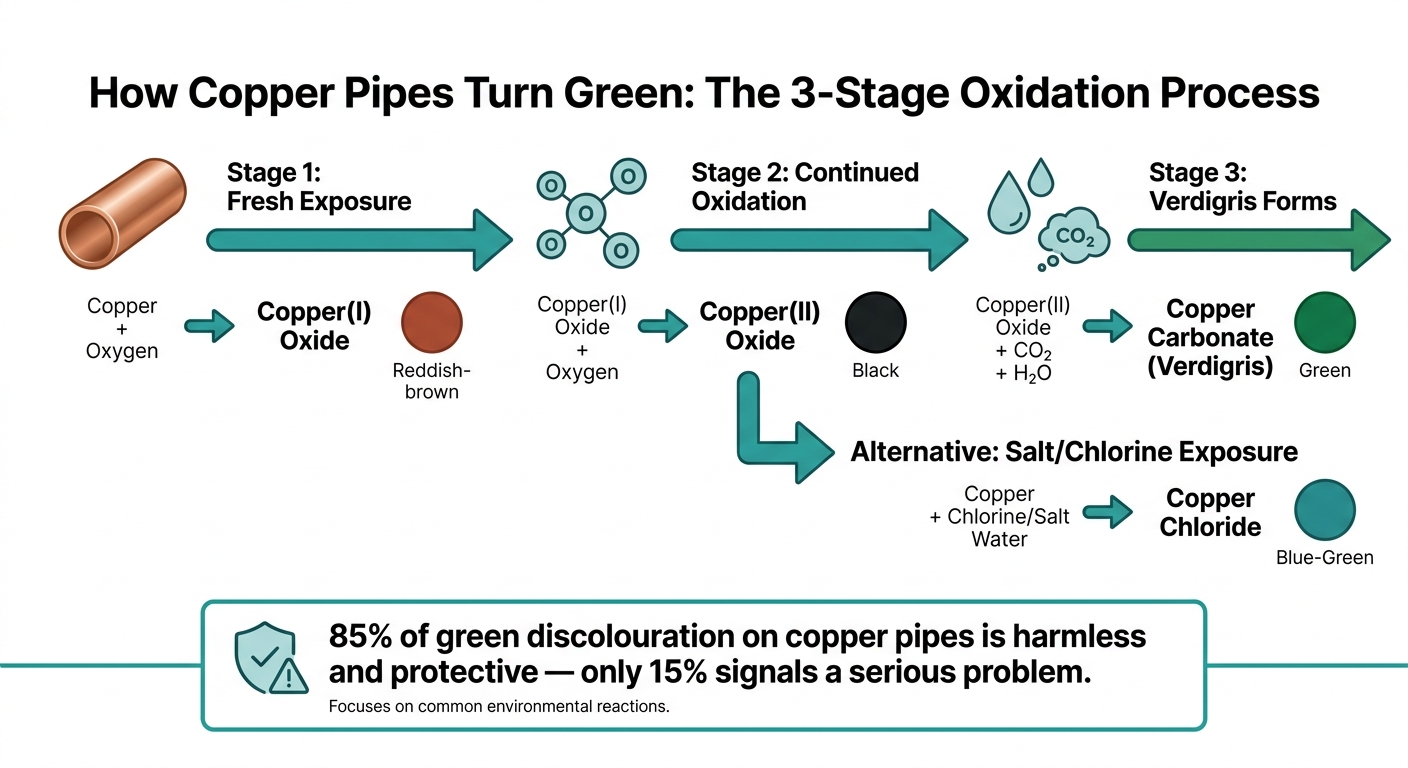
How Copper Pipes Turn Green: The 3-Stage Oxidation Process
Copper pipes develop a green coating due to natural chemical reactions. Initially, copper reacts with oxygen, forming copper(I) oxide, which gives the surface a reddish-brown hue. Over time, this oxide reacts further with oxygen, creating copper(II) oxide, which darkens the surface to black. Eventually, the copper(II) oxide interacts with moisture and carbon dioxide, forming copper carbonate – commonly known as verdigris, the green layer often seen on copper surfaces.
| Stage | Reaction Components | Resulting Compound | Appearance |
|---|---|---|---|
| 1 | Copper + Oxygen | Copper(I) Oxide | Red/Brownish |
| 2 | Copper(I) Oxide + Oxygen | Copper(II) Oxide | Black |
| 3 | Copper(II) Oxide + CO₂ + H₂O | Copper Carbonate (Verdigris) | Green |
| Alternative | Copper + Chlorine/Salt Water | Copper Chloride | Blue-Green |
This green verdigris layer serves as a passivation layer, creating a stable barrier that helps protect the underlying metal by slowing further corrosion. In fact, about 85% of green discolouration found on the exterior of copper pipes is generally harmless. However, while this external layer is mostly benign, internal corrosion poses a more serious concern, which is addressed in the next section.
Common Causes of Green Copper Pipes
There are several reasons why copper pipes develop a green coating, known as verdigris. Each cause has its own characteristics and solutions, so understanding them can help address the issue effectively.
High Humidity and Condensation
Moisture is the primary reason copper pipes turn green. When humid air or condensation settles on the surface of a pipe, it speeds up the oxidation process that leads to verdigris. This is particularly common in areas like basements, crawl spaces, and utility rooms, where poor ventilation traps moisture.
In fact, external moisture is responsible for about 60% of cases involving green discolouration on copper pipes. Pipes located near exterior walls or water heaters are especially prone to this because of temperature differences that promote condensation. Using a dehumidifier or sealing off crawl spaces can help reduce moisture and slow down this process.
Water Leaks
When leaks occur, they often leave behind a concentrated green buildup, typically around joints, fittings, or elbows. Unlike the uniform green coating caused by humidity, this type of corrosion is more localized and often mixed with white mineral deposits.
Pinhole leaks are particularly tricky because the mineral deposits can temporarily seal the hole, hiding the problem until the buildup eventually breaks apart. These leaks account for roughly 15% of green copper pipe cases. If you notice thick green corrosion in a specific area, especially near a fitting, it’s worth investigating further to rule out an active leak.
Water Chemistry Problems
The composition of your water supply can significantly affect how quickly copper pipes corrode. Acidic water (with a pH below 7) is especially harmful, as it eats away at the pipe from the inside, speeding up internal corrosion. Hard water can also accelerate the formation of green copper salts on the pipe’s exterior.
“Acidic water (low pH below 7), high dissolved oxygen, or high chlorine content can corrode copper from the inside.” – Total Mechanical Care
High levels of dissolved oxygen and chlorine in municipal water supplies are also common culprits. If you notice green-tinted water or green stains around sink drains, it could mean copper is leaching into your water – a more serious issue than surface discolouration. The age of your plumbing system can further influence how water chemistry impacts corrosion.
Aging Plumbing Systems
Copper pipes are known for their durability, often lasting 50 years or more, but they don’t last forever. Over time, the protective lining inside the pipes wears down, leaving the metal more vulnerable to corrosion. Older systems are also more likely to have mineral buildup, micro-cracks, and thinning areas that make it easier for corrosion to take hold.
If your home has plumbing that’s several decades old, green discolouration may indicate that the system is nearing the end of its lifespan, rather than being just a cosmetic issue.
Improper Installation
Installation mistakes can worsen corrosion. For example, acidic flux residue left behind at soldered joints is a common issue. If this residue isn’t cleaned off properly after soldering, it reacts with the copper, causing green discolouration around the joint. While this type of corrosion is often just cosmetic, it can hide deeper problems if ignored.
Additionally, pipes installed without proper support or placed in direct contact with concrete or masonry are more susceptible. Materials like concrete and brick retain moisture, which can keep the pipe’s surface damp and accelerate the formation of verdigris over time.
Environmental Factors
External conditions can also speed up green discoloration on copper pipes. High humidity, poor ventilation, air pollution, exposure to cleaning chemicals, and contact with damp building materials can accelerate oxidation. This is why pipes in basements, crawl spaces, laundry rooms, utility areas, or older homes may develop green patina faster than pipes in dry, well-ventilated spaces.
Is Green on Copper Pipes Dangerous?
When it comes to green discolouration on copper pipes, understanding the difference between harmless and hazardous signs is essential. While most exterior green marks are harmless, the situation changes when green appears internally. In fact, 85% of exterior green discolouration is just verdigris, a natural oxidation layer that actually protects the copper. But if you notice green-tinted water or stains around sink drains, this could mean copper is leaching into your water – a potential health risk. Health Canada has set the maximum safe level of copper in drinking water at 1.3 mg/L. If your water exceeds this limit, it’s time to act immediately.
If copper levels in drinking water become too high, some people may experience nausea, vomiting, stomach pain, or gastrointestinal discomfort. The risk depends on the copper concentration, water usage, and individual sensitivity. This is why green-tinted water or blue-green stains around fixtures should not be ignored.
Another warning sign is damp, green buildup on pipes. This often points to a pinhole leak, which can cause serious problems like wood rot, mould growth, and structural damage to walls and floors. Mould, in particular, can lead to respiratory issues for those living in the home.
Here’s a quick guide to help you distinguish between cosmetic issues and more serious concerns:
| Sign | What It Likely Means | Action Needed |
|---|---|---|
| Light, dry green coating along a long section of pipe | Harmless verdigris (oxidation) | Improve ventilation or reduce humidity |
| Damp or concentrated green spot | Possible pinhole leak | Professional inspection recommended |
| Green staining in sinks or green-tinted water | Copper leaching into water supply | Discontinue use; test water chemistry immediately |
| Dry green rings around soldered joints | Leftover flux residue | Cosmetic issue; monitor for moisture |
If you notice dampness near green spots or an unexpected spike in your water bill, these could be signs of a more serious issue. In such cases, a professional inspection is essential. The next section will guide you through the necessary steps to address these problems.
How to Inspect Copper Pipes for Damage
Once you’ve spotted a potential issue – like a damp green patch on a pipe or an unusual spike in your water bill – the next step is a thorough inspection. Fortunately, you don’t need fancy tools to get started. A simple flashlight and a dry paper towel can help you figure out if you’re dealing with a minor concern or something more serious.
Start by visually checking all accessible pipes, especially in areas like basements, crawl spaces, or utility rooms. Pay close attention to green patches on the pipes. If the green is evenly spread, it’s often harmless oxidation caused by external moisture. However, as Total Mechanical Care explains:
“Green on the OUTSIDE of pipes: Usually harmless oxidation from external moisture. Cosmetic in most cases. Green INSIDE pipes or green-tinted water: This is an entirely different, and more serious problem.”
To check for active leaks, press a dry paper towel against any green or crusty spots. If the towel comes away wet, stained blue-green, or if you hear a faint hissing sound near the pipe, you might have a pinhole leak that needs immediate attention.
Take a closer look at soldered joints and fittings. Green rings or halos around these areas are often just leftover flux from the soldering process. But if you see tiny pits or indentations in the metal, it could mean the pipe is starting to weaken. Don’t forget to inspect nearby materials like drywall, nails, or joists for signs of rust, water stains, or mould, which could hint at hidden leaks.
Finally, examine your fixtures and water quality. Stains with a blue-green tint in sinks, tubs, or toilet tanks, or water that tastes metallic when you first turn on the tap, are strong signs of internal pipe corrosion. If these issues show up alongside visible damage to your pipes, it’s time to call a licensed plumber for a detailed evaluation.
How to Clean Green Copper Pipes
If your inspection reveals that the green discolouration is just cosmetic, you’re in luck – about 85% of green stains on the outside of copper pipes are harmless, caused by oxidation or leftover flux from soldering. However, if the pipe feels damp or shows signs of pitting, it’s time to call a professional plumber.
For surface oxidation, mix a paste using vinegar and baking soda. Apply it to the affected area, let it sit for about 10 minutes, then wipe it off and dry the pipe thoroughly.
For light surface stains, homeowners can also use a lemon juice and salt paste. Apply it gently with a soft cloth, then rinse and dry the pipe completely. Avoid abrasive cleaners, harsh chemicals, or aggressive scrubbing, as these can damage the copper surface or make corrosion worse.
If the green is from flux residue, you’ll need something abrasive, like emery cloth or steel wool, to scrub it away.
After cleaning, make sure the pipe is completely dry to avoid new oxidation. For regular maintenance, use a microfiber cloth, mild detergent, and a soft brush. The goal is to remove surface buildup without scratching the copper or leaving moisture behind. If you plan to paint the pipe, prep is key: clean and dry it first, then apply a metal primer designed for copper. Skipping this step can trap moisture under the paint, which accelerates corrosion, as noted by Total Mechanical Care.
Keep an eye on the pipe after cleaning. If the green patina comes back quickly or the area stays damp, it could signal a pinhole leak or a humidity problem that needs expert attention.
How to Prevent Copper Pipes From Turning Green
Preventing green discolouration on copper pipes mainly involves controlling moisture levels and keeping an eye on water quality. Since about 60% of green pipe cases are linked to external moisture like humidity and condensation, keeping the environment around your pipes dry is one of the most effective steps you can take.
In areas like basements or crawl spaces, improving airflow and using a dehumidifier can help reduce moisture levels. You might also consider encapsulating crawl spaces and insulating pipes with foam or fibreglass to prevent condensation. As VERTEX explains:
“The best way to prevent pipes from condensing is to prevent the ambient air from reaching them in the first place. The simplest way to accomplish this is to wrap the pipes in insulation.”
In some visible or exposed areas, a protective coating may help reduce direct contact with moisture and air. However, coatings should only be applied to clean, dry pipes. If there is dampness, pitting, or active corrosion, the pipe should be inspected before any coating is used, because covering the problem can trap moisture and make the damage worse.
Water quality is another critical factor. If you notice blue-green stains around drains or fixtures, it could mean your water is too acidic. Testing your water’s pH can confirm this – anything below 7 indicates acidity. Installing a neutralising filter can help prevent internal corrosion. The EPA recommends a copper level of no more than 1.3 mg/L in drinking water; higher levels suggest a need for treatment. Combining water quality improvements with regular maintenance will help keep your pipes in good shape.
In addition to water quality, there are other simple ways to prevent corrosion. For instance, keep an eye on your monthly water bill. An unexpected spike could signal hidden plumbing leaks, which might lead to moisture build-up and pipe damage.
A consistent maintenance routine also plays a big role in prevention. Here’s a quick guide to help you stay on top of things:
| Maintenance Action | Frequency | Purpose |
|---|---|---|
| Visual inspection | Every 6–12 months | Look for damp spots, green crust, or mineral deposits |
| Humidity check | Seasonally | Ensure basements and crawl spaces stay dry to avoid verdigris |
| Water bill review | Monthly | Spot hidden leaks early |
| Professional assessment | Every 2–3 years | Ideal for systems over 30 years old to catch ageing-related issues |
When to Call a Plumber for Green Copper Pipes
A plumber should inspect green copper pipes if the buildup is damp, concentrated around joints, returns quickly after cleaning, or appears together with low water pressure, metallic-tasting water, green stains in fixtures, or rising water bills. Professional inspection can confirm whether the issue is only surface oxidation, leftover soldering flux, water chemistry, or an active leak. In some cases, plumbers may recommend pipe cleaning, protective treatment, leak repair, water testing, or partial pipe replacement.
Do Green Copper Pipes Need Replacement?
Not always – but in some cases, yes. While green discolouration on copper pipes is often just a cosmetic issue, green-tinted tap water or internal green deposits are signs of more serious corrosion that might require immediate attention. Regular inspections, as mentioned earlier, can help detect these issues before they become major problems.
The most obvious warning sign is green-tinted tap water or green deposits inside fixtures, which indicate severe internal corrosion. If you notice either of these, it’s time to call a professional for an assessment.
The lifespan of your plumbing is another factor to consider. Copper pipes are known to last over 50 years, but after 30–40 years, they may start to corrode more quickly. If leaks become frequent, it could mean it’s time to replace the entire system.
Here’s a quick reference for when replacement might be necessary:
| What You See | Likely Cause | Recommended Action |
|---|---|---|
| Concentrated green crust with dampness | Active pinhole leak | Repair the section or consider a full repipe |
| Green-tinted tap water | Internal corrosion/leaching | Seek immediate professional assessment |
When these signs are present, evaluating replacement options becomes critical.
If repairs are no longer practical, a full system replacement is the safest route. In Canada, the cost of a full repipe typically ranges from $4,500 to $15,000, so acting promptly can help you avoid additional damage and expense. Many homeowners choose to replace corroded copper with PEX tubing (cross-linked polyethylene), a flexible material that resists corrosion and pitting, extending the lifespan of your plumbing system.
For homeowners in Toronto and the GTA, POM Plumbing Service Company offers over 20 years of experience. They handle everything from assessing your pipes to managing permits and even wall patching, ensuring the repiping process is as smooth as possible.
Conclusion: Keeping Copper Pipes in Good Condition
Understanding and addressing green oxidation is essential for maintaining the health of your plumbing system.
Green oxidation on copper pipes is a common issue and is often manageable. In most cases, it results from factors like moisture, leftover soldering flux, or active leaks. Only a small number of instances lead to serious structural or health concerns.
Watch for warning signs such as green-tinted water or visible dampness, as these indicate it’s time to take action. Regular inspections and monitoring can help you avoid expensive repairs down the road.
Taking simple steps like improving ventilation and testing your water’s chemistry can extend the lifespan of your copper pipes to over 50 years. These precautions align with earlier advice to protect your plumbing system.
For more serious problems, especially those beyond surface oxidation, it’s best to call in the experts. POM Plumbing Service Company has been assisting homeowners in Toronto and the GTA for over 20 years. They offer a range of services, including leak detection, pipe inspections, and complete repiping solutions, all delivered by licensed and insured professionals with transparent pricing.
FAQs
Verdigris is the even green or blue-green patina that naturally develops on copper pipes over time due to oxidation. However, when leaks occur, they can lead to uneven green corrosion, along with dampness or visible water stains in the area. To spot a potential leak, watch for signs like irregular corrosion, active moisture, or pooling water. Unlike the stable nature of verdigris, corrosion caused by leaks often signals damage that requires further inspection.
If you spot green discolouration on your pipes – particularly alongside leaks or signs of corrosion – it’s a good idea to test your water for copper. This can reveal whether the water’s chemistry is playing a role in oxidation and possibly damaging your pipes.
Yes, you can paint over green copper pipes, but preparation is key. The surface needs to be cleaned thoroughly to remove any oxidation, dirt, or grime. Proper preparation ensures that the paint sticks well and doesn’t peel or flake later on.
Yes, using natural cleaning agents and regular maintenance practices can be effective DIY solutions.
Costs vary depending on the extent of the issue. Repair costs may be lower than complete replacement, but long-term investment in quality materials is advisable.
