



Did you know your drinking water could contain harmful contaminants like lead, arsenic, or bacteria – even if it looks clean? Regular water testing is the only way to ensure your water is safe for consumption and won’t damage your plumbing system.
Here’s what you need to know:
- Invisible Risks: Contaminants such as E. coli, nitrates, or heavy metals often have no taste, smell, or colour.
- Health Hazards: Exposure to substances like lead, arsenic, or PFAS can lead to serious health issues, including cancer and developmental problems in children.
- Plumbing Damage: Hard water and corrosion can cause pipe blockages, leaks, and reduce the lifespan of appliances.
- Testing Frequency: Health Canada recommends testing private wells for bacteria twice a year and checking for chemicals every two years.
- DIY vs. Professional Testing: DIY kits are affordable but limited, while professional testing offers precise, certified results that can detect trace contaminants.
If you depend on private wells or live in areas like the GTA, where chloride levels from road salt are a concern, testing is even more critical. A professional service ensures accurate results, identifies risks, and helps maintain both your health and plumbing system.
Contents
- 1 The Importance of Water Testing & Why There is No One-Size-Fits-All Water Filter
- 2 What Is Water Quality Testing?
- 3 Common Water Contaminants Found in Homes
- 4 Health Risks of Poor Water Quality
- 5 How Water Quality Affects Your Plumbing System
- 6 Signs Your Water May Need Testing
- 7 How Often Should Water Be Tested?
- 8 Professional Water Quality Testing vs. DIY Kits
- 9 What Happens After a Water Test?
- 10 Conclusion
- 11 FAQs
- 12 Related Blog Posts
The Importance of Water Testing & Why There is No One-Size-Fits-All Water Filter
sbb-itb-1e3c609
What Is Water Quality Testing?
Water quality testing involves monitoring and analysing drinking water to ensure it’s free from harmful microbial or chemical contaminants that exceed the limits set by the Guidelines for Canadian Drinking Water Quality. Think of it as a health check for your water, identifying hidden dangers that aren’t visible to the naked eye. This process looks for microbial contaminants like E. coli, total coliforms, viruses, and protozoa, as well as chemical substances such as lead, arsenic, copper, manganese, nitrates, and uranium. It also measures operational factors like pH levels, iron, water hardness, and total dissolved solids (TDS) to confirm the water meets national safety standards. These tests are essential because they catch problems that a simple visual inspection could never detect.
POM Plumbing Service Company provides highly accurate testing services for both residential and commercial properties in Toronto and the GTA. Their licensed experts use certified collection kits to gather and label samples, which are stored at 2–8 °C to maintain integrity. Samples must reach the lab within 48 hours, as anything above 25 °C is rejected to ensure reliability. The company employs the Membrane Filtration technique with DC Agar to detect and count Total Coliforms and E. coli, achieving 93% sensitivity and 91% specificity in their accredited lab analyses.
In Canada, municipal water systems are regulated at the provincial level. However, private well owners are responsible for independently testing their water. By following strict testing protocols, even the most subtle threats can be identified before they pose health risks or cause damage to plumbing systems.
Common Water Contaminants Found in Homes
Water in Canadian homes can carry a variety of contaminants, often introduced through natural sources, aging infrastructure, or human activities. Microbial contaminants like E. coli, total coliforms, viruses, and protozoa can enter water supplies through failing septic systems, animal waste, or surface runoff into shallow wells. These bacteria are signs of fecal contamination and can lead to gastrointestinal illnesses.
Heavy metals, including lead, arsenic, uranium, and copper, may contaminate water through corroded pipes, natural geological leaching, or corrosive water conditions. In urban areas like the GTA, older water distribution lines increase the risk of lead exposure. Meanwhile, rural regions often face higher levels of nitrates and pesticides due to agricultural activity.
Chemical contaminants are another concern. Nitrates and nitrites, often from agricultural runoff, fertilizers, manure, or sewage, can compromise water quality. PFAS, also known as "forever chemicals", originate from industrial products, firefighting foams, and landfills. These substances persist in the environment, moving through soil and water. Health Canada has established a precautionary guideline of 30 ng/L for a combination of 25 specific PFAS in drinking water. Additionally, municipal water treatment can create chlorine byproducts, like trihalomethanes, when disinfectants react with organic matter.
Aesthetic factors can affect water quality without posing direct health risks. For instance, water hardness is caused by naturally occurring calcium and magnesium from sedimentary rocks such as limestone and dolomite. Chloride levels, often rising due to road salt use, can also impact water quality. Another common issue is hydrogen sulphide, which forms when organic matter decomposes or when sulphate-reducing bacteria are active, giving water a "rotten egg" odour.
"Many contaminants won’t affect the smell, taste or colour of your drinking water. Even if your water seems fine, you can’t know for sure without testing." – Health Canada
Recognizing these contaminants is the first step towards evaluating the health risks they may pose.
Health Risks of Poor Water Quality
Contaminated water can lead to both immediate and long-term health problems, depending on the type of contaminants present. Microbial contaminants like E. coli, viruses, and protozoa often cause acute issues such as nausea, vomiting, and diarrhoea. In some cases, they can even lead to infections affecting the respiratory system or central nervous system. On the other hand, chemical contaminants may take years to show their effects, though exposure to certain chemicals – like nitrates or high levels of copper – can cause illness even after a short period.
Certain groups are more vulnerable to these contaminants. Infants, children, seniors, pregnant individuals, and those with weakened immune systems face higher risks. Lead is particularly harmful to developing brains and can pass from a pregnant individual to their fetus or through breast milk. This exposure can result in reduced cognitive abilities and behavioural challenges in children. Nitrates pose a severe risk to bottle-fed infants by causing blue baby syndrome (methaemoglobinaemia), while manganese in formula-fed infants can impair memory, attention, and motor skills.
"Drinking water that contains lead, even for a short time, can be a health risk. Most at risk, because of their developing brains, are fetuses, infants, and children." – Health Canada
Long-term exposure to chemical contaminants can have grave consequences. Arsenic, for instance, is associated with a higher risk of lung, bladder, liver, and skin cancers, as well as vascular and neurological damage. Prolonged exposure to uranium can harm the kidneys and bones, while copper can cause short-term gastrointestinal issues and, over time, lead to liver and kidney damage. Substances like PFAS (per- and polyfluoroalkyl substances) are linked to adverse effects on the liver, thyroid, kidneys, immune system, and metabolism. To address these risks, Health Canada has established Maximum Acceptable Concentrations for these contaminants in its Guidelines for Canadian Drinking Water Quality.
Private well owners, who supply water to about 4 million Canadians, shoulder the responsibility of ensuring their water is safe. Health Canada recommends testing for microbial contaminants at least twice a year and checking general water quality every two years. Since many harmful contaminants don’t alter the water’s taste, smell, or appearance, regular testing through accredited laboratories or local public health units is the only reliable way to confirm water safety.
Next, we’ll look at how these health risks can impact your plumbing system.
How Water Quality Affects Your Plumbing System
Poor water quality doesn’t just pose health risks – it can also wreak havoc on your plumbing system. When water interacts with metal pipes, it triggers an electrochemical reaction that causes corrosion. This process can release harmful metals like lead and copper into your water or create scale deposits that clog pipes. Over time, corrosion weakens pipe walls, making them prone to small leaks, especially in copper pipes.
Hard water, rich in calcium and magnesium, adds another layer of trouble. It leaves behind limescale inside pipes – whether they’re metal, plastic, or cement. This buildup narrows the pipe’s diameter, restricting water flow. If left unchecked, it can lead to complete blockages and reduce the efficiency and lifespan of appliances.
Homes with Kitec piping, a common choice in Canada between 1995 and 2007, face unique challenges. These systems are particularly vulnerable to dezincification, a process where zinc leaches out of brass fittings due to exposure to moisture and oxygen. This leads to internal blockages and, unlike gradual leaks in standard pipes, Kitec pipes are prone to sudden bursts, which can cause extensive flooding and water damage.
"Corrosion deposits in pipes also provide a major reservoir for a broad variety of contaminants, some of which are a health concern." – Health Canada
If your home was built or renovated between 1995 and 2007 – or if you’ve noticed issues like reduced water pressure or discoloured water – professional inspection and testing are crucial. Companies like POM Plumbing Service Company offer Kitec piping replacement services and maintenance plans that include regular inspections and system flushing to prevent scale buildup. Routine water quality testing can also detect corrosive conditions or hard water problems early, helping to safeguard your plumbing system and your investment.
These plumbing issues are clear indicators that it might be time to test your water quality.
Signs Your Water May Need Testing
The appearance of your water often provides the first hint that something might be off. If you notice red, orange, or brown stains, it could mean there’s a high iron content. Black stains often point to manganese. Meanwhile, chalky residues on faucets and appliances are a telltale sign of hard water’s threat to your plumbing.
Changes in taste, smell, or clarity are just as critical. A salty flavour might indicate elevated sodium levels, while a metallic taste could suggest copper, zinc, or iron contamination. If your water appears cloudy or suddenly becomes murky, it might signal bacterial contamination or sediment. However, some of the most harmful contaminants – like arsenic, lead, and E. coli – are completely odourless, colourless, and tasteless. Often, subtle sensory changes are the first indicators that something’s wrong.
As Halton Region explains:
"Contaminated water may be odourless, colourless, and tasteless. Testing your well water is the best way to ensure the safety of your well water supply."
Unexplained health symptoms, such as nausea, vomiting, or diarrhea, may also point to microbial contamination in your water. Environmental factors like heavy rains, flooding, droughts, or nearby construction can disrupt groundwater quality, making immediate testing a priority. These risks highlight the importance of regular water testing to safeguard your home and health.
If you notice any of these warning signs, it’s crucial to act quickly. Scheduling a professional inspection can help identify whether the problem lies in the water source or your plumbing system. POM Plumbing Service Company can assess and address these issues, ensuring your water remains safe and your infrastructure stays intact. Regular testing and upkeep can catch problems early, preventing costly repairs and health concerns down the line.
How Often Should Water Be Tested?
Once you’re aware of potential warning signs, the next step in managing water safety is understanding how often to test. The frequency largely depends on your water source. If you’re connected to a municipal system, your municipality handles monitoring and treatment based on provincial standards. But for private well owners, the responsibility for water safety falls entirely on you.
Health Canada and provincial guidelines recommend testing private wells for microbial contaminants twice a year – ideally in early spring and fall, when surface contamination risks are highest. Chemical testing, covering substances like arsenic, lead, nitrates, and uranium, along with general water quality checks (e.g., pH, hard water solutions, iron), should be done every two years.
For those using surface water sources like lakes or rivers, bacterial testing is also advised every six months, while chemical testing should occur annually.
Certain situations demand immediate testing. Events like heavy rainfall, floods, droughts, wildfires, or any maintenance work can compromise water quality. If you notice unusual changes in taste, smell, or colour, testing should be a priority. This is especially important for households with infants, seniors, pregnant individuals, or immunocompromised members.
To put this into perspective, about four million Canadians rely on private wells for drinking water, and in Nova Scotia alone, over 40% of households use private wells. The cost of bacterial testing typically ranges from $30 to $50, while a comprehensive chemical analysis can cost between $200 and $300.
To make things easier, companies like POM Plumbing Service Company offer maintenance plans that include regular water quality monitoring. These plans take care of scheduling and lab coordination, so you don’t have to.
Regular testing isn’t just about meeting guidelines – it’s a proactive way to avoid health risks and expensive plumbing issues, especially for shallow or dug wells, which are more susceptible to contamination.
Professional Water Quality Testing vs. DIY Kits
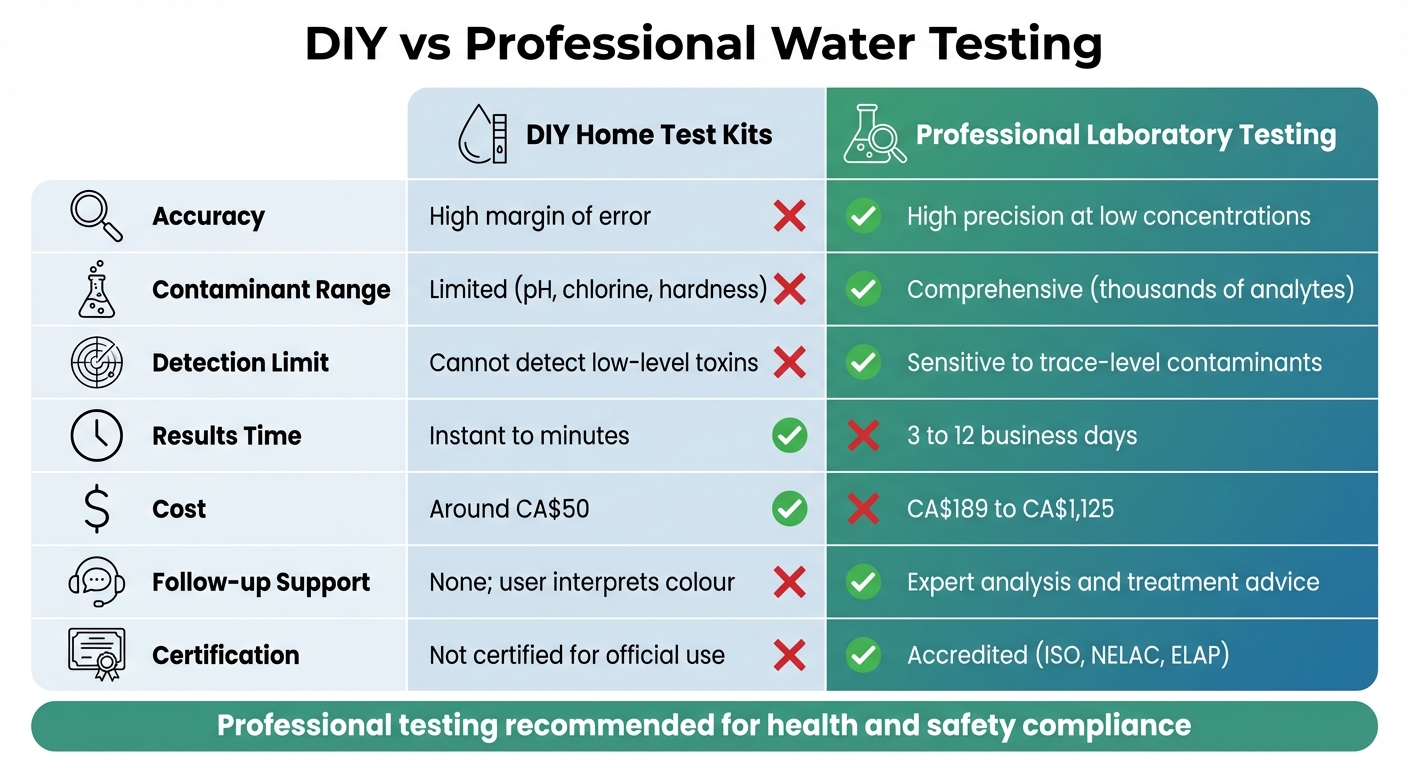
DIY vs Professional Water Testing: Accuracy, Cost and Coverage Comparison
Testing your water is essential for maintaining both your health and the longevity of your plumbing system. But how do you choose the right method? The decision often comes down to DIY test kits versus professional laboratory testing, and the differences are significant.
DIY water testing kits are a budget-friendly option, typically costing around CA$50. They provide quick results for basic parameters like pH, chlorine, and water hardness. While convenient for routine checks, these kits have some major drawbacks. The results rely on colour-matching, which can be subjective and prone to user error. More importantly, they cannot detect low levels of harmful contaminants, such as PFAS, lead, or pesticides. In short, DIY kits work well for simple checks – like pH or total dissolved solids (TDS) – but they fall short when it comes to identifying serious health risks.
On the other hand, professional laboratory testing offers a much deeper and more reliable analysis. These tests, starting at CA$189 and going up to CA$1,125 for comprehensive panels, can detect thousands of contaminants with incredible precision, even at trace levels. While the results take longer – between 3 and 12 business days – you receive a detailed report that includes expert interpretation, a health risk assessment, and tailored recommendations for water treatment. This level of detail is especially important when addressing concerns like lead in older plumbing systems or selecting the right filtration system.
Another critical factor is certification. Only accredited laboratory tests meet Health Canada standards and are accepted for regulatory compliance or official documentation. DIY kits, no matter how advanced, cannot provide certified results. This makes professional testing essential for situations where accuracy and compliance matter most.
A trusted provider like POM Plumbing Service Company simplifies the process by handling everything – from sample collection to lab submission and expert interpretation. This ensures you receive actionable, trustworthy guidance based on certified findings. Be cautious of "free" water tests offered by some treatment companies; these are often marketing tactics designed to sell unnecessary products.
Comparison Table
| Factor | DIY Home Test Kits | Professional Laboratory Testing |
|---|---|---|
| Accuracy | High margin of error | High precision at low concentrations |
| Contaminant Range | Limited (e.g. pH, chlorine, hardness) | Comprehensive (thousands of analytes) |
| Detection Limit | Cannot detect low-level toxins | Sensitive to trace-level contaminants |
| Results Time | Instant to minutes | 3 to 12 business days |
| Cost | Around CA$50 | CA$189 to CA$1,125 |
| Follow-up Support | None; user interprets colour | Expert analysis and treatment advice |
| Certification | Not certified for official use | Accredited (e.g. ISO, NELAC, ELAP) |
What Happens After a Water Test?
When your water test results arrive – usually within 4 business days for laboratory analysis – POM Plumbing Service Company gets to work by comparing the findings to the Guidelines for Canadian Drinking Water Quality. This step helps identify any contaminants that exceed acceptable health or aesthetic limits. The analysis focuses on microbial indicators, heavy metals, and factors like pH and hardness, which can affect your plumbing system.
If the results reveal any immediate concerns, safety measures are put into place. For residential clients in Toronto and the GTA, the detection of E. coli or total coliforms triggers a recommendation to stop using the water for consumption. Until the issue is resolved, boiled or bottled water becomes the safe alternative. The next step involves shock disinfection of your well and household plumbing, followed by a re-test to confirm the bacteria have been eliminated. As highlighted by Ottawa Public Health:
"The more samples you have tested, the more confident you can be about the quality of the water you are drinking".
For commercial properties, the process includes additional regulatory steps. POM Plumbing works with local Public Health Units to ensure compliance with Ontario’s Safe Drinking Water Act. This involves determining risk categories and adhering to directives issued by Public Health Inspectors.
The solutions recommended depend on the specific findings. For instance, if lead levels exceed 0.005 mg/L, replacing lead service lines is the most effective solution. If hardness levels surpass 180 mg/L as CaCO₃ (classified as "Very Hard"), ion exchange water softeners are suggested to prevent scale buildup in pipes and appliances. For water with a "rotten egg" smell caused by hydrogen sulphide, aeration or oxidation systems are used to eliminate the odour.
POM Plumbing takes care of everything – from interpreting the results to installing systems and conducting follow-up tests. This ensures your water meets Health Canada standards and addresses any issues, whether they involve bacteria, chemical contaminants, or aesthetic concerns affecting your plumbing.
Conclusion
Regular water quality testing is essential for safeguarding both your health and your plumbing system. As Health Canada points out, "Many contaminants won’t affect the smell, taste or colour of your drinking water. Even if your water seems fine, you can’t know for sure without testing". This is particularly important for private well owners, who don’t benefit from government monitoring.
Testing for bacterial contaminants every six months and evaluating overall water quality every two years can help prevent health issues and protect your plumbing. Factors like hardness, pH, iron levels, and high TDS can lead to scaling, which reduces the lifespan of appliances.
For residents in Toronto and the GTA, POM Plumbing Service Company brings over 20 years of expertise in water quality testing. They handle everything from lab analysis and result interpretation to treatment installations and follow-ups. Whether dealing with lead service lines in older Toronto homes, bacterial contamination, or damage caused by hard water, professional testing ensures your water complies with Canadian standards.
Keeping your water safe doesn’t just protect your health – it also preserves your plumbing investment. As noted earlier, "The plumbing inside your home is an extension of the distribution system". With licensed and insured professionals, POM Plumbing provides the knowledge and services you need to maintain safe drinking water and ensure your plumbing operates effectively.
FAQs
What should I do if my water test finds E. coli?
If your water test reveals the presence of E. coli, stop using the water right away for drinking or cooking. You’ll need to disinfect your well or water system and then retest to make sure the issue has been resolved. E. coli in your water means it’s unsafe to consume and demands immediate action to protect your health.
Which water tests should I prioritize for an older home?
When dealing with older homes, it’s important to check for microbial contaminants such as bacteria and viruses, along with chemical contaminants that could seep from old pipes or fixtures. These tests help ensure your water is safe and compliant with quality standards. This is particularly crucial for spotting potential hazards linked to outdated plumbing systems.
Can water testing help me choose the right filtration system?
Water testing pinpoints the exact contaminants present in your water, allowing you to select a filtration system tailored to address those specific issues. This helps make your water safer and more suitable for everyday use.